Midnight, the Nursery Light, and the Sound I Will Never Forget
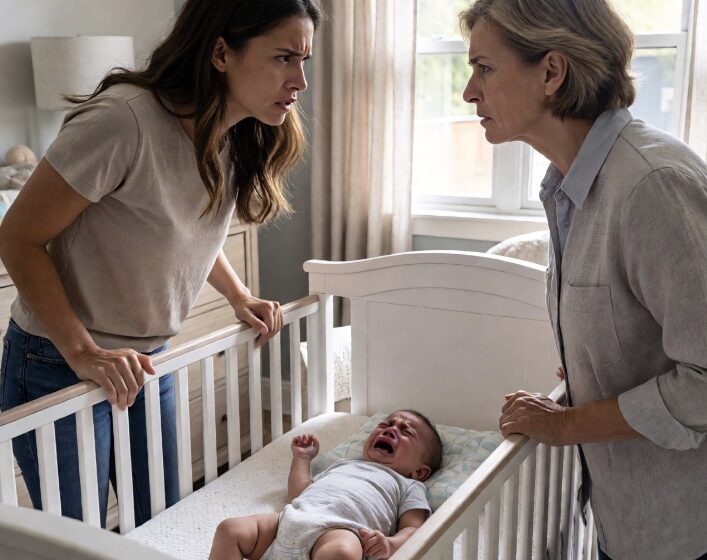
For a long moment, the only sound in the room was my baby’s thin, exhausted crying against my shoulder—the unsteady rise and fall of a newborn who doesn’t yet know the difference between discomfort and fear. Sophie was three days old, still curled inward the way new babies are, her tiny fingers clamped around my thumb as I paced the nursery in slow circles, whispering nonsense sounds meant to soothe both of us.
The night felt too quiet. Too watchful.
When I turned toward the doorway, I froze.
My mother-in-law, Marjorie, stood perfectly still in the dim spill of the hallway light. In her right hand, she held a small pair of sewing scissors. In the other, she clutched the edge of the doorframe as if bracing herself for something difficult but necessary.
“I’m fixing this child,” she whispered, her voice steady in the way people sound when they’ve convinced themselves they’re right.
My blood went cold.
Behind her, my husband stirred awake on the couch, confusion creasing his face as he took in the scene. His gaze moved from the scissors to Sophie’s tiny, sleeping hand, then back to his mother.
“What are you doing?” he asked, his voice rough with sleep.
Marjorie’s eyes flicked to him, then sharpened when they returned to me.
“You’re lying,” she said suddenly, as if responding to an argument that had been happening only in her head. “That can’t be true. My son is perfect.”
The word perfect landed with a weight that didn’t belong to a human being.
My husband swallowed. I watched something shift in him—not anger at first, but the slow collapse of a story he had lived inside for years.
“I’m not perfect,” he said quietly. “Dad told me what happened when I was older. A doctor changed my hands when I was a newborn. I always thought you knew.”
Marjorie’s fingers trembled. For the first time, certainty cracked. Fear flashed across her face—and then stubbornness rushed in to replace it.
I didn’t raise my voice. I didn’t plead.
“Put them down,” I said, surprised by how calm I sounded. “Right now.”
She hesitated, eyes darting as if searching for a version of reality where she could still be right. Then she placed the scissors on the dresser with exaggerated care, like she was proving they had never been dangerous. My husband stepped forward immediately, picked them up, and placed them high on a shelf.
“What were you thinking?” he demanded.
“I was helping,” she insisted. “People are cruel. You can’t send a child into the world looking different.”
“She’s three days old,” I said. “And you brought scissors into her nursery in the middle of the night.”
Her voice rose. “It was just a tiny fix.”
“Stop,” my husband snapped. “Don’t say another word.”
The Hospital, the Confession, and the Truth She Couldn’t Outrun
We didn’t debate. Debate gives dangerous ideas room to breathe.
I wrapped Sophie in a blanket and walked out. My husband followed, grabbing his keys. Behind us, Marjorie called out, her voice shifting into pleading.
“Don’t turn this into a big thing.”
But the size of something isn’t measured by how small the cut would have been. It’s measured by the belief behind the blade.
At the emergency department, the lights were harsh and the air smelled faintly of antiseptic and old coffee. When the nurse asked what happened, the truth came out clean and unsoftened.
“My mother-in-law brought scissors into the nursery,” I said. “She intended to alter my newborn.”
A social worker joined us. The doctor explained, gently, that Sophie’s hands were healthy, that any future decisions would be made with medical guidance and consent—hers, when she was old enough. No one in that room treated my child like a problem to erase.
When asked about family history, my husband spoke with the blunt honesty of someone done with protecting secrets.
“I was altered as a newborn,” he said. “Because my mom couldn’t stand the idea of a flaw.”
Dawn, the Driveway, and the Boundary That Held
When we pulled into our driveway near dawn, Marjorie’s car was still there, parked with stubborn familiarity. She opened the door before we reached it.
“Are you satisfied now?” she snapped. “You dragged strangers into this.”
My husband stepped forward, blocking her view of Sophie.
“You need to leave,” he said. “Right now.”
“You’re choosing her over your own mother?” she shot back.
“I’m choosing my daughter,” he replied. “And you are not safe.”
Her certainty wavered.
“If you had it too—”
“Then it came from somewhere,” he said evenly. “And it’s not shameful. What you did is.”
She left without another word.
A Smaller Family, a Safer Home
Two days later, she tried to come back. My husband didn’t open the door.
From then on, boundaries were no longer suggestions. Visits ended. Drop-ins stopped. The pressure to “keep the peace” disappeared, replaced by something steadier: safety.
Sophie grew. Her tiny hand curled around my finger with absolute trust. My husband grieved the mother he thought he had—and became the father he needed to be.
Sometimes, when Sophie cries at night, I still feel the echo of that moment in the doorway. But I also feel something else.
Certainty.
Love that is safe listens.
Love that controls cuts.
And our daughter will grow up knowing the difference.

Sophia Reynolds is a dedicated journalist and a key contributor to Storyoftheday24.com. With a passion for uncovering compelling stories, Sophia Reynolds delivers insightful, well-researched news across various categories. Known for breaking down complex topics into engaging and accessible content, Sophia Reynolds has built a reputation for accuracy and reliability. With years of experience in the media industry, Sophia Reynolds remains committed to providing readers with timely and trustworthy news, making them a respected voice in modern journalism.