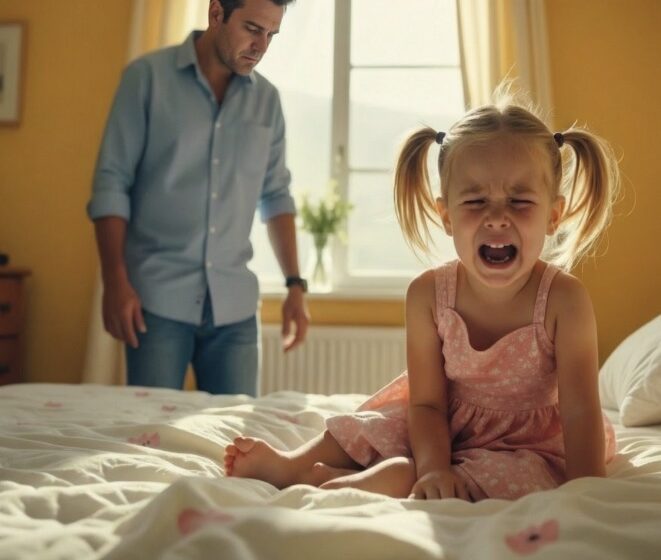
The late afternoon at the emergency dispatch center in Cedar Ridge, Illinois, moved with the dull rhythm of routine—traffic fender benders, neighborly disputes over fences, the occasional wellness check that ended in a sheepish apology. The operator on duty had just lifted her cooling coffee when the line lit up again.
“911, what’s your emergency?” she said, the practiced warmth in her voice shaped by years of learning how to sound calm when panic was waiting on the other end.
For a moment, all she heard was breathing. Small. Careful. The sound of someone trying not to make noise.
“I… I’m not supposed to call,” the child whispered.
The operator leaned closer to her screen. “You’re okay. You can talk to me. What’s your name?”
Another pause. Fabric rustled. Something bumped softly in the background.
“Lila,” the voice said.
“That’s a lovely name, Lila. Can you tell me what’s happening right now?”
The child hesitated, then repeated the sentence as if reading from memory.
“He told me it only hurts the first time.”
The operator’s fingers stilled over the keyboard.
She had heard fear. She had heard screams. She had heard lies told to protect abusers.
But this sounded rehearsed. Conditioned. A sentence given to a child so she could survive something she didn’t understand.
“Who told you that, sweetheart?” the operator asked gently.
“Mr. Nathan,” Lila whispered.
“Where is your mom right now?”
“She’s tired. She’s working a lot.”
The operator flagged the call for immediate response and kept her voice slow and steady, guiding Lila to stay on the line until she heard the knock at the door.
The House That Looked Safe
When Sergeant Thomas Avery arrived at Willow Bend Drive, the house looked like dozens of others he had visited over the years—small porch, children’s chalk drawings fading into the concrete, curtains pulled just enough to suggest privacy without secrecy. The kind of place neighbors described as “quiet” in a way that meant they didn’t ask questions.
Marissa Cole answered the door with an apologetic smile.
“I’m so sorry if there’s been some kind of mistake. My daughter doesn’t usually play with phones.”
Thomas didn’t contradict her. He simply asked to step inside.
The house smelled faintly of something medicinal, sharp beneath the cleaner’s lemon scent. On the coffee table, next to overdue bills, sat a small plastic container of supplements with handwritten labels. In the hallway, Lila hovered, clutching her stuffed rabbit like a shield.
Thomas crouched. “Hi, Lila. I’m Tom.”
Her eyes flicked to her mother, then back to him.
“Hi.”
“You did the right thing calling,” he said softly.
Her brow furrowed. “Mr. Nathan says calling makes things worse.”
That sentence told Thomas more than any bruise could have.
The Man Who “Helped”
Nathan Holloway arrived ten minutes later, as if summoned by timing alone. He brought calm with him the way some people bring weather—quiet voice, smooth movements, confident smile. The kind of man who sounded reasonable until you listened carefully to what he was actually saying.
He spoke of “natural protocols,” of “avoiding unnecessary hospitals,” of “teaching children resilience through discomfort.”
Lila repeated his words like scripture.
“He said it only hurts the first time.”
Thomas stepped outside and made the call he didn’t want to have to make. The one that meant the situation was no longer just a wellness check.
The Moment Everything Changed
Lila’s fever spiked while they were still talking. She swayed where she stood, her rabbit slipping from her grip. Marissa caught her just in time, panic flashing across her face.
Nathan reached for his case.
“I have something stronger. She just needs to push through.”
Thomas stepped in front of him.
“No. She doesn’t.”
Marissa’s voice broke. “I thought I was helping her. I thought I was doing what I was supposed to do.”
Eleanor Briggs, the child advocate Thomas had called, met Marissa’s eyes.
“Being a good mother doesn’t mean knowing everything,” she said gently. “Sometimes it means knowing when to ask for help.”
Marissa nodded through tears.
They went to the hospital.
After the Sirens Faded
The full truth came out slowly.
The “vitamins” weren’t vitamins.
The “treatments” weren’t safe.
And the man who claimed to help families had no legitimate credentials at all.
Lila spent several days under observation. The bruising faded. The fever broke. Clover, her rabbit, no longer wore bandages, no longer served as a stand-in for pain she had learned to normalize.
Thomas visited once before his shift ended.
“You’re pretty brave,” he told her.
She shook her head.
“I was scared.”
“That’s what brave looks like,” he said.
Marissa squeezed her daughter’s hand. For the first time in months, the exhaustion on her face wasn’t mixed with helplessness—just relief.
Why That Call Mattered
Thomas listened to the recording of the 911 call one last time before it was archived. The words stayed with him.
It only hurts the first time.
So many children learn to accept pain because someone they trusted told them to.
So many adults don’t notice the warning signs because the house looks quiet, the street looks safe, the story sounds reasonable enough.
But this time, a child whispered.
And someone listened.

Sophia Reynolds is a dedicated journalist and a key contributor to Storyoftheday24.com. With a passion for uncovering compelling stories, Sophia Reynolds delivers insightful, well-researched news across various categories. Known for breaking down complex topics into engaging and accessible content, Sophia Reynolds has built a reputation for accuracy and reliability. With years of experience in the media industry, Sophia Reynolds remains committed to providing readers with timely and trustworthy news, making them a respected voice in modern journalism.