The Birthday Party That Didn’t Feel Safe
The backyard looked like every other children’s party I had ever endured with a polite smile: pastel balloons tugging at their strings, a folding table sagging under paper plates and bright frosting, relatives laughing as though nothing in the world were darker than a kid spilling punch on a new shirt. My nephew was turning six. The adults passed cake like ritual, talked about school districts and mortgage rates, and I told myself that showing up mattered, because family was supposed to be the place where you could breathe.
I only stepped inside to find my daughter. I hadn’t seen her in a while, and the kind of quiet that follows a four-year-old is never peaceful. It’s the kind that makes your body understand something your mind is still trying to deny. I walked the hallway toward my parents’ bathroom, calling softly, pretending calm because I didn’t want to alarm anyone unless I had to.
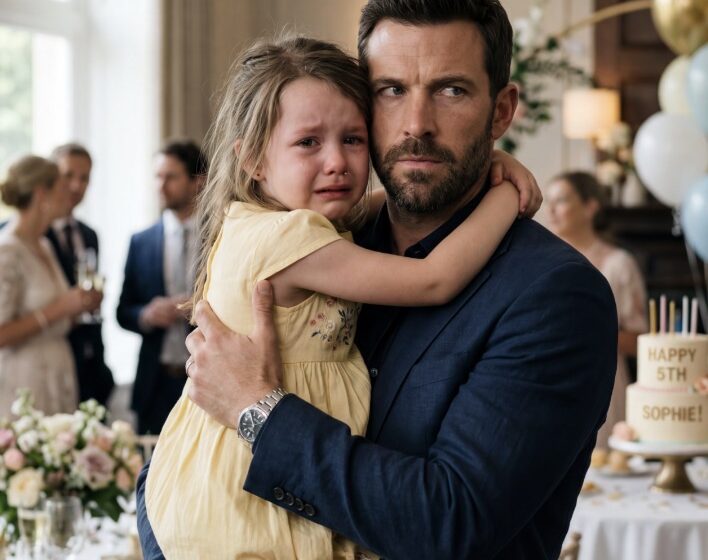
When I opened the door, Lily was crouched behind the toilet, pressed into the corner like she had tried to disappear into the tile. Her small body shook so hard I could feel it before I touched her. Her eyes were unfocused in a way that hollowed my chest. She didn’t scream or run to me. It looked like she had already learned that loud reactions sometimes make things worse.
I lowered myself carefully, keeping my voice gentle even as my pulse roared.
“Sweetheart, it’s Dad,” I whispered, hands open. “Come here. You’re okay. I’ve got you.”
She reached for me with stiff, hesitant arms. When I pulled her against my chest, I saw the swelling along one side of her face — the kind that doesn’t come from bumping into a doorframe. As I adjusted her sleeves, my stomach dropped. Several sharply defined round marks dotted her arms, too uniform to be accidental. The room narrowed to a tunnel of breath and heat.
I didn’t ask her to explain. She was trembling and exhausted, and all that mattered was getting her out of that room, out of that house, away from the people laughing in the backyard like nothing could reach them.
I carried her through the hallway and into the living room, past the buffet table and framed family photos. I stopped in the middle of the room, where everyone could see, holding Lily so her face was hidden, and looked directly at my sister, Tessa Lane, who sat on the couch with a wineglass tilted in her hand like she was hosting a fundraiser instead of a child’s birthday party.
My voice surprised me with how steady it sounded.
“Who did this?”
Tessa blinked, then laughed loudly enough to pull attention.
“Oh my God, relax. It was just a joke. She was whining. She needs to toughen up.”
The room tilted, not with dizziness but disbelief. My mother, Linda, half-stood as if to stop the scene before it embarrassed anyone. My father, Robert, stiffened near the kitchen doorway, already scanning for witnesses.
“You don’t get to call that a joke,” I said quietly. “You don’t get to touch my child again. Ever.”
Tessa’s smile sharpened. “You’re being dramatic.” She wobbled as she stood.
I didn’t want a scene. I wanted the door. But when she reached toward Lily like she had the right to prove control, my body moved on instinct. I shoved her hand away and turned — and my mother’s voice snapped across the room.
“Get back here! Don’t you dare do this to us.”
A glass shattered against the wall near the doorway. The silence that followed was the kind that means something irreversible just happened. I didn’t argue. I walked out with Lily in my arms, locked the car doors, and drove straight to urgent care.
The Morning They Begged for the Wrong Person
By dawn, documentation was done. Lily leaned into me, wrapped in a blanket, and I kept my hand on her back like touch itself could anchor her to safety.
The next morning, pounding hit my front door. My mother stood on the porch, makeup smeared, grief shaped for performance. She dropped to her knees, clutching my pant leg.
“Please,” she sobbed. “Give your sister a way out of this. Don’t destroy her life.”
She didn’t ask how Lily was. She didn’t ask what Lily needed. The tragedy, to her, was consequences.
“Get off my property,” I said evenly. “If you don’t, I’ll call the police and file everything.”
“She didn’t mean it,” my mother rushed. “She had a few drinks. You can’t do this to her. You’ll ruin her job. You’ll take her child’s mother away. You’ll make us look like—”
“You’re begging for the wrong person,” I said. “If you want to help someone, admit what happened and stay away from my daughter.”
“You’re heartless,” she spat. “She’s your sister.”
“And Lily is my child,” I said. “That’s not a debate.”
I closed the door and leaned against it, breathing like I had finally stepped out of a tunnel.
Evidence, Messages, and the Price of Telling the Truth
Strangers are easy to name as threats. Family comes wrapped in holidays and history, and people use that to shame you into silence. The police took statements. Clinicians documented what they saw. I kept every record, because I knew my family would rewrite the story.
They did.
My father’s voicemails slid from accusation into threat. My mother’s texts never asked about Lily’s nightmares — only about my nephew’s inconvenience. I told them once, clearly, they were not permitted near my child.
In court, excuses collapsed under documentation. My sister called it “discipline.” The judge called it what it was.
Afterward, my mother hissed, “You ruined her life.”
“Lily wakes up startled,” I said. “She flinches at sudden movement. Let’s talk about that instead of how inconvenient consequences are.”
“You’re not my son anymore,” she said.
“That’s the first thing we’ve agreed on in years,” I replied, and walked away.
The Family We Built After the Cut
Healing wasn’t dramatic. It was routines, therapy, patience, and rebuilding predictability. The nightmares softened. The flinching eased. Lily laughed again, not because she forgot, but because she felt safe.
The people who became our family weren’t blood. They showed up without conditions. I changed locks, updated pickup lists, and learned that boundaries don’t need approval to be real.
Some nights I grieved the family I thought I had. Then the truth settled in: cutting ties with people who protect harm isn’t betrayal. It’s protection.
Our life became smaller in number and stronger in honesty.
And the absence of constant guilt felt like air.

Sophia Reynolds is a dedicated journalist and a key contributor to Storyoftheday24.com. With a passion for uncovering compelling stories, Sophia Reynolds delivers insightful, well-researched news across various categories. Known for breaking down complex topics into engaging and accessible content, Sophia Reynolds has built a reputation for accuracy and reliability. With years of experience in the media industry, Sophia Reynolds remains committed to providing readers with timely and trustworthy news, making them a respected voice in modern journalism.