That was the moment I realized how fast love can twist into fear.
My name is Hannah Collins, and our daughter, Ivy Collins, was born at St. David’s Medical Center in Austin, Texas. She came into the world pink, loud, and absolutely perfect—except for one small surprise. Each tiny hand had an extra finger along the pinky side.
The pediatrician called it postaxial polydactyly. He explained calmly that it’s often genetic and usually harmless. Sometimes the extra digits are removed later in a simple procedure. Sometimes families choose to leave them. Either way, there was no emergency.
“Just don’t let anyone try to handle it themselves,” he warned gently.
My husband, Ethan Collins, nodded.
His mother, Margaret Collins, did not.
From the second she noticed Ivy’s hands, Margaret couldn’t disguise her discomfort. “That’s not normal,” she muttered in the hospital room. “People will stare.”
“The doctor isn’t worried,” I told her.
She gave a tight smile. “Doctors overlook things.”
We brought Ivy home on a quiet Thursday evening. Ethan collapsed onto the couch, exhausted. I stayed awake in the nursery, hovering the way new mothers do—counting breaths, adjusting blankets, memorizing every tiny sound.
At 12:14 a.m., Ivy started screaming. Not a soft cry. Sharp. Urgent.
I hurried down the hallway.
The nursery light was already on.
The door stood slightly ajar.
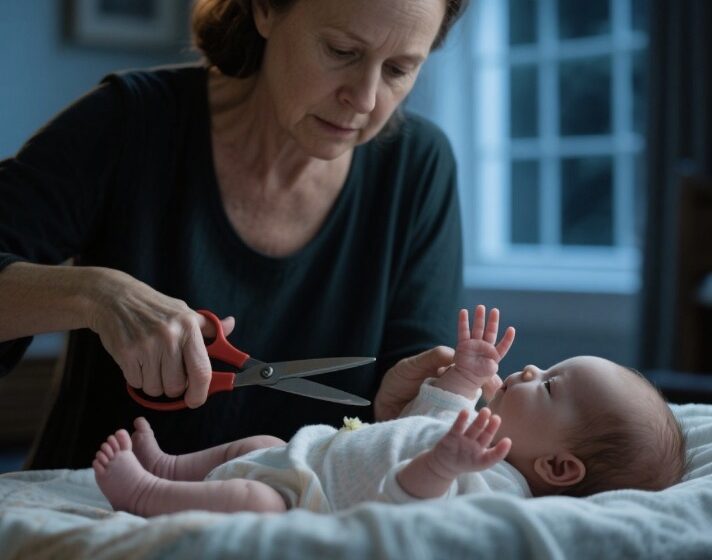
Margaret was at the changing table. Ivy’s tiny arm lay stretched across a folded towel. In Margaret’s hand—an old pair of silver sewing scissors.
The blades were positioned around my daughter’s extra finger.
For a split second, my body forgot how to move.
“What are you doing?” I heard myself say.
Margaret didn’t look ashamed. She looked resolved.
“I couldn’t let her grow up like that,” she said calmly. “I fixed it.”
I lunged forward and lifted Ivy into my arms. The extra finger was still there—but a thin line of blood marked where the metal had pressed too hard.
“Are you out of your mind?” I shouted, my voice breaking.
“She won’t remember,” Margaret insisted. “It’s better this way.”
Ethan appeared in the doorway, pale and disoriented. “Mom?”
Clutching Ivy, shaking, I said something I hadn’t rehearsed.
“The doctor said it’s genetic. Ethan… tell her.”
Ethan went very still. Then he looked at our daughter’s hands—really looked at them.
“Mom,” he said quietly, “I was born with them too.”
The room emptied of sound.
Margaret blinked. “No, you weren’t.”
“I was,” he said. “Dad told me when I was older. They had them removed when I was a baby. I thought you knew.”
The color drained from Margaret’s face. The first thing I saw wasn’t guilt—it was shock, as if the floor beneath her certainty had cracked open.
For a moment, the only sound was Ivy sobbing against my shoulder.
Then I said, steady and unmistakable, “Put the scissors down.”
We went to the emergency room that night. Thankfully, Ivy’s injury was minor—no damage beyond a small cut.
But when the doctor asked what happened, I told the truth.
An official report was filed. A social worker arrived. It was humiliating and surreal—but necessary.
When we came home at dawn, Margaret tried to argue that we were “overreacting.”
Ethan stood between her and the nursery door.
“You’re leaving,” he said. “And you’re not coming back until we decide it’s safe.”
She accused me of turning him against her.
He answered simply, “I’m choosing my daughter.”
That was the last time she entered our home.
In the weeks that followed, we learned more. The trait ran in Ethan’s father’s family. His grandfather had it. It wasn’t a defect. It wasn’t a curse. It was inherited biology.
But to Margaret, it symbolized something she couldn’t accept—imperfection.
We began therapy—not because our daughter was flawed, but because we refused to let fear shape her life. Ethan started unpacking what it meant to grow up beneath conditional approval—the constant polishing, correcting, perfecting.
Months later, we met with a pediatric hand specialist. There was no urgency. We could choose later whether to remove the extra fingers surgically in a controlled environment—or leave them as they were.
For now, we chose to wait.
Because there was nothing about Ivy that needed fixing.
Margaret sent letters. Some apologetic. Some defensive. We didn’t reply.
Our family became smaller—but stronger. More deliberate.
One night, months later, Ivy wrapped all six tiny fingers around mine and squeezed with surprising strength. I looked at her hands—at every perfect, extra part of her—and felt something steady settle inside me.
The hardest part wasn’t the hospital trip.
It wasn’t the report.
It was realizing that someone who claimed to love her had tried to change her before she was even a week old.
But here’s what I understand now:
Love does not cut away what makes you different.
Love protects it.
And every night when I step into that nursery, I’m grateful for two things:
The door is closed to harm.
And open only to those who understand that my daughter was never something to fix.

Sophia Reynolds is a dedicated journalist and a key contributor to Storyoftheday24.com. With a passion for uncovering compelling stories, Sophia Reynolds delivers insightful, well-researched news across various categories. Known for breaking down complex topics into engaging and accessible content, Sophia Reynolds has built a reputation for accuracy and reliability. With years of experience in the media industry, Sophia Reynolds remains committed to providing readers with timely and trustworthy news, making them a respected voice in modern journalism.