The Essay That Started Everything
Ten-year-old Emily Carter pressed her pencil carefully against the lined page.
She always stuck her tongue slightly out when concentrating, especially when something mattered to her.
That morning, her class at Brookfield Elementary was working on a Career Day assignment. Parents sat along the back wall drinking coffee while students wrote short essays answering one simple question:
“What do your parents do for a living?”
Emily thought about her parents.
Her father always looked tall and serious when he left for work wearing his uniform.
Her mother came home every evening smelling faintly of lemon cleaning solution after long days working in other people’s houses.
Emily didn’t think one job was more important than the other.
To her, they both meant the same thing.
They meant family.
So she wrote carefully:
My father is General Jonathan Carter.
My mother, Maria Carter, is a housekeeper.
Both of them serve people.
She even drew a tiny star beside the word general and a little broom beside housekeeper.
Emily smiled.
She was proud of both.
When No One Believed Her
Her teacher, Mrs. Whitaker, began collecting the essays.
When she reached Emily’s desk, she glanced down.
Then she looked again.
Her smile disappeared.
“Emily,” she said loudly enough for others to hear, “this isn’t a joke assignment.”
Emily blinked in confusion.
“It’s not a joke.”
Mrs. Whitaker lifted the paper.
“A general?” she said with a short laugh. “Your mother cleans houses. Let’s not invent stories.”
Several parents shifted uncomfortably.
Emily’s cheeks turned red.
“It’s true,” she whispered.
The teacher crossed her arms.
“Emily, we don’t make up things to impress people.”
“I’m not making it up.”
The teacher sighed.
“Then prove it.”
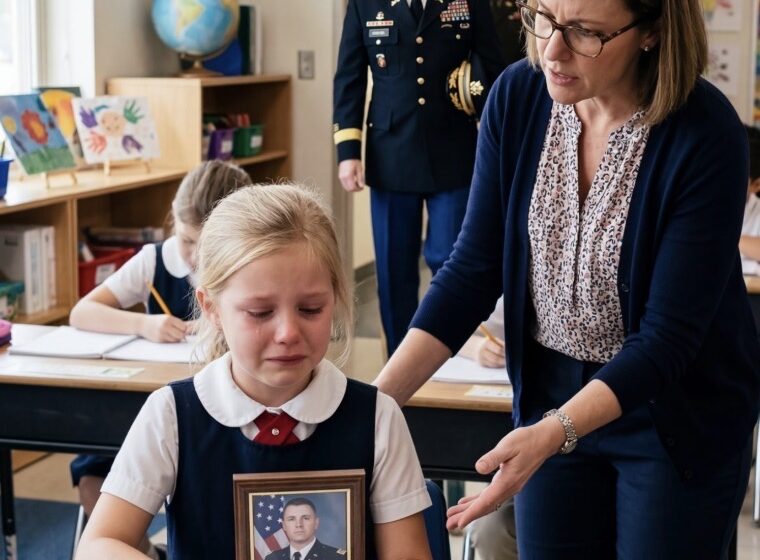
Emily slowly pulled a photograph from her backpack.
It showed her father in military uniform, medals shining, with Emily and her mother standing beside him.
Mrs. Whitaker barely glanced at it.
“Costume photos happen all the time.”
Then she tore the essay in half.
The ripping sound filled the classroom.
Emily stared at the broken paper.
Sent To The Principal
“Go to the principal’s office,” the teacher said sharply. “And explain why you insisted on telling a story instead of the truth.”
Emily gathered the torn pieces of paper and walked down the quiet hallway.
Principal Daniel Brooks looked up from his desk when she entered.
“Your teacher says you caused a disturbance.”
Emily placed the torn essay on his desk.
“My dad is coming today,” she said quietly.
The principal leaned back in his chair.
“Your father?”
“He said he would come at ten.”
The principal glanced at the clock.
“Emily, sometimes stories feel real to us, but they’re still stories. I think it would be best if you rewrote your essay and admitted it wasn’t true.”
Emily shook her head slowly.
“I told the truth.”
Principal Brooks sighed.
“Then we’ll wait and see.”
The Sound In The Hallway
At 9:58 a.m., heavy footsteps echoed through the hallway.
Slow.
Measured.
The school secretary rushed into the office looking pale.
“Sir… someone important is here.”
A moment later the office door opened.
A tall man stepped inside wearing a perfectly pressed Army dress uniform.
Four silver stars shone on his shoulders.
Principal Brooks stood up so quickly his chair scraped across the floor.
“General Carter…?”
The officer nodded calmly.
“I’m here for my daughter.”
Emily jumped from the chair.
“Dad!”
The general knelt and hugged her.
Then he looked at the torn essay in her hands.
“Someone said this wasn’t true?”
The Moment Of Silence
They walked together to the classroom.
When they entered, every voice stopped.
Parents stood.
Mrs. Whitaker froze beside her desk.
General Carter held up the torn paper.
“My daughter wrote about her parents,” he said calmly.
Mrs. Whitaker tried to speak.
“I believed she was exaggerating—”
“You didn’t ask,” he replied quietly. “You decided.”
The room remained silent.
Then Emily spoke softly.
“Dad… they wanted me to rewrite it and say it was just a story.”
The general looked down at her.
“Well,” he said gently, “was it?”
Emily hesitated.
Then something surprising happened.
She smiled.
The Twist
“Actually…” Emily said.
“It is a story.”
The room blinked in confusion.
Emily turned to her classmates.
“Our assignment was to write about our parents. But I thought it would be fun to write a story instead.”
The teacher stared.
“So… your father isn’t a general?”
Emily shook her head.
“No.”
The tall man beside her smiled.
“My name is Jonathan Carter, but I’m actually an actor.”
The room erupted in laughter and relieved murmurs.
Emily explained proudly.
“My dad helped me act out the ending so everyone would remember the story.”
The principal exhaled slowly.
Mrs. Whitaker rubbed her forehead.
Emily looked at her teacher.
“But the story still has a point.”
She held up the torn paper.
“Sometimes adults decide something isn’t true before they even listen.”
The classroom went quiet again.
The Lesson
Later that day, Emily rewrote her essay.
At the top she added one more line.
This story isn’t real. But the lesson is.
Don’t judge people before you hear the whole story.
When she finished reading it to the class, even Mrs. Whitaker nodded thoughtfully.
Because sometimes the most powerful lessons come from stories that were never meant to be true—but still reveal something very real about how we treat each other.

Sophia Reynolds is a dedicated journalist and a key contributor to Storyoftheday24.com. With a passion for uncovering compelling stories, Sophia Reynolds delivers insightful, well-researched news across various categories. Known for breaking down complex topics into engaging and accessible content, Sophia Reynolds has built a reputation for accuracy and reliability. With years of experience in the media industry, Sophia Reynolds remains committed to providing readers with timely and trustworthy news, making them a respected voice in modern journalism.