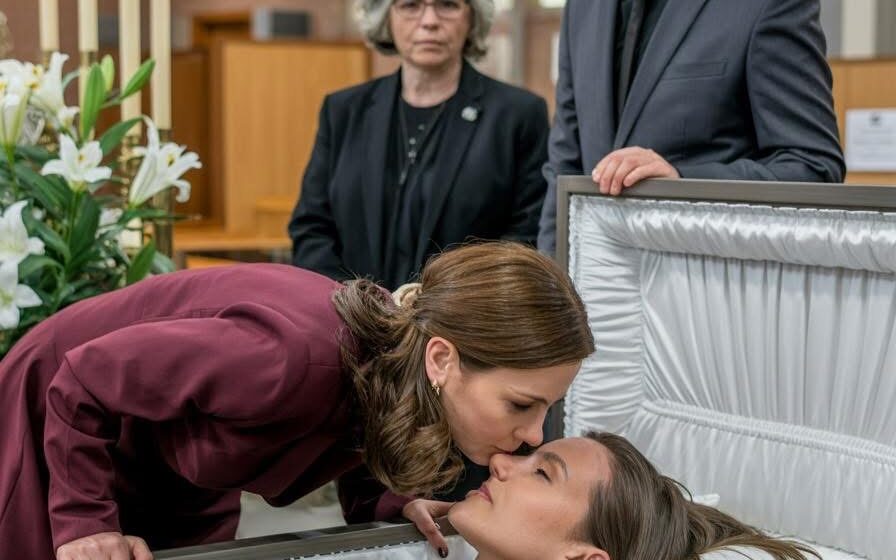
At My Daughter’s Funeral, Her Husband’s Mistress Whispered “I Won” Until the Will Was Read and Everything Changed

Just as the service reached that fragile, suspended moment, the church doors swung open.
The sharp sound of heels echoed across the marble floor, too loud, too cold, completely out of place. Every head turned. The sound ricocheted off the high ceilings and the stained glass and the polished pews, and it carried with it something that had no business being in a place like this, something almost triumphant.
My son-in-law, Ethan Caldwell, walked in laughing.
Not slowly. Not respectfully. Not even attempting to perform grief for the benefit of the room. He strode down the aisle like a man arriving at a celebration, his suit perfectly tailored, his hair neatly styled, his chin up at an angle that said he had decided this room and everyone in it was beneath his concern. On his arm was a young woman in a bold red dress, smiling with the easy confidence of someone who had no idea where she was standing or what that coffin meant or who was inside it.
The room shifted. Whispers spread in waves from the front pews to the back. Someone gasped. A woman near the aisle put her hand over her mouth. The priest stopped mid-sentence, his place in the liturgy dissolving into the sudden heavy silence of a room that could not look away.
Ethan didn’t care.
“Traffic downtown is terrible,” he said casually, dropping the words into the silence the way someone drops a coat on a chair, thoughtlessly, without looking to see if anything is already there.
He wasn’t apologizing. He was explaining his own tardiness as if the inconvenience was ours.
The woman beside him glanced around the church with something close to curiosity, her eyes moving over the flowers and the candles and the photographs of Emily propped near the altar, taking it all in like she was visiting somewhere she had heard about but never been. As she moved past me, she slowed almost imperceptibly. For a moment I thought she might offer condolences, some small human gesture that would let me believe she had some understanding of what this day was. Instead she leaned in close, and her voice dropped to something cold and precise and deliberate.
“Looks like I won.”
Something inside me broke.
I wanted to scream. I wanted to pull her away from that coffin by her perfectly styled hair and hold her face close enough to that photograph of my daughter to make her understand what she was looking at, who she was looking at, what had been done to the person in that box. I wanted Ethan to feel, just once, even a fraction of what my daughter had felt on the nights she locked herself in the bathroom and called me from the floor with her voice barely above a whisper, telling me not to worry, telling me she was fine, telling me things would get better soon.
I didn’t move.
I clenched my jaw. Fixed my eyes on the casket. Breathed, slowly, from the bottom of my lungs, the way you breathe when you are holding something enormous inside yourself and the only thing preventing it from escaping is the act of breathing. Because if I opened my mouth in that moment I would not be able to stop, and my daughter deserved a service, not a scene. She had been denied enough dignity while she was alive. I was not going to let anyone take it from her in death.
My daughter’s name was Emily Carter. She was thirty-one years old when she died. She was the kind of person who remembered the exact day you mentioned something in passing and brought it up weeks later because she had been thinking about it. She laughed at her own jokes before she finished telling them, which made the jokes funnier without being funny at all. She sent cards by mail, real ones with handwritten notes, for birthdays she had never needed a reminder for. She cried at commercials that featured elderly people and at videos of animals being rescued and at the end of books she had already read twice before and knew were going to break her heart again.
She believed in things. That was her essential quality. She believed in people’s capacity to change, in love as a renewable resource, in the idea that if you were patient enough and kind enough and present enough, you could eventually reach the goodness in someone who was struggling to find it themselves.
She had come to see me a few weeks before she passed, wearing long sleeves in the middle of summer. Florida in July, the kind of heat that sits on your skin from the moment you step outside, and Emily was wearing a soft blue cardigan buttoned to the wrist.
“I’m just cold, Mom,” she said, before I could ask. She said it with that practiced ease of someone who had given the same answer enough times to make it sound unrehearsed.
I pretended to believe her because I was afraid of what would happen if I didn’t, because I had learned that pushing Emily too hard too fast sent her retreating into herself and back to him, and because there is a particular cowardice that looks like patience when you are trying to protect a relationship with your child.
There were other visits, other signs I absorbed and did not speak aloud. She smiled too brightly sometimes, the kind of brightness that sits just above the eyes and never quite reaches them, her face performing happiness while something underneath it was very still and very careful. She talked about Ethan in the language of someone managing your worry before they manage their own, preemptively explaining his behavior before you had asked, translating his cruelty into stress, his coldness into busyness, his control into concern.
“Ethan’s just stressed,” she would say. “Work has been a lot. He doesn’t mean it the way it comes out.”
“Come home,” I told her, more than once, in more than one conversation. “Just come home for a while. You can think about everything from here. You’re safe with me.”
“It’ll get better,” she said, and the certainty in her voice was the most heartbreaking thing about it, because it was real. She genuinely believed it. “Now that the baby’s coming, everything will change. He’s excited. He’s going to be different.”
She had been pregnant. Eight weeks when she came to see me in the cardigan. She lost the pregnancy six weeks later under circumstances that Ethan described to anyone who asked as a tragic accident.
I did not believe him. I had not believed him for a long time. But grief is not evidence, and love is not a court, and I had no way to prove what I suspected was true.
She died two weeks after the miscarriage. The official cause was listed as a fall. Ethan told the police she had tripped at the top of the stairs in their home.
I am her mother. I know my daughter. Emily was careful, deliberate, someone who moved through the world with attention. She did not trip.
But I am getting ahead of the story.
Back in the church, Ethan dropped into the front pew like he owned it, which given everything was an act of contempt so brazen it almost demanded admiration for its sheer audacity. He settled in with his arm around the woman in red as if they were waiting for a show to start, and he actually chuckled at something she whispered to him while the priest was speaking about eternal love. Not quietly. Not a restrained exhale of breath that could be written off as a cough. An audible, unguarded chuckle, while his wife lay in a casket ten feet away.
I felt physically ill. The kind of nausea that is less about your stomach and more about the sudden understanding that the world contains people who are capable of this, who can stand in a house of grief and feel nothing but their own comfort, who can arrive at their wife’s funeral with another woman and laugh.
That was when I noticed the man standing in the side aisle.
Michael Reeves. Emily’s attorney. I barely knew him. I had met him once, briefly, at a coffee shop near their neighborhood. Emily had mentioned she had retained him for some estate planning, some paperwork she said I didn’t need to worry about, standard things, she had said, and I had nodded and not pressed because she seemed calm when she said it and I was always trying to read her calm as genuine.
He was quiet, Michael. The kind of serious that is not coldness but rather a particular density of purpose, the quality of a person who understands the weight of what they are carrying and chooses to carry it carefully. He stood in the aisle holding a sealed envelope, and the way he held it, with both hands, with attention, told me before he said a word that what was inside mattered.
Because it did.
He stepped forward into the aisle and when he moved the room noticed, the way a room notices when something is about to change. He walked to the front, near the altar, near the coffin, and he cleared his throat. The sound was enough. The room, which had been unable to fully settle since Ethan’s entrance, went quiet.
“Before the burial,” Michael said, his voice measured and carrying, “I am required to carry out a direct legal instruction from the deceased. Her will is to be read now.”
A ripple moved through the pews. People shifted in their seats. Heads turned toward husbands and toward sisters and toward old friends, the silent exchange of raised eyebrows that asks did you know about this? The priest gave a small, measured nod from his position at the altar, which told me this had been arranged in advance, that Michael had spoken with someone before the service and that what was happening was not interruption but instruction.
Ethan scoffed. He did it audibly and without embarrassment.
“A will?” He said it the way you say a word when you think the concept itself is slightly ridiculous. “My wife didn’t have anything.”
Michael looked at him. Not with contempt, not with anger, not with any particular expression at all. Just looked at him with the steady attention of someone who has already read the document and knows how the story ends.
“I’ll begin with the primary beneficiary,” Michael said.
He opened the envelope.
Then he said my name.
“Margaret Carter. Mother of the deceased.”
My knees went soft. It happened before I could prepare for it, before I could brace against it. I grabbed the pew beside me and held on because the room had tilted and I needed something solid, something real, something I could press my palms against to confirm I was still standing. The woman next to me put her arm around my waist. I barely registered it. I was thinking about my daughter.
Even in death, she was still trying to protect me. Still thinking ahead. Still making sure I would be okay. While she was living through what she was living through, while she was documenting it and meeting with lawyers and building a legal case in secret, she had also been making sure her mother would be provided for.
That was Emily. That was entirely, completely, heartbreakingly Emily.
Ethan was on his feet before Michael had finished saying my name.
“That’s impossible. There must be a mistake.” The confidence in his voice was the confidence of a man who has never been truly held accountable, the confidence that comes from a lifetime of explanations being accepted and doubts being smoothed over and consequences never quite arriving.
Michael did not look up from the document.
Emily had left everything to me. Her home. Her savings account. Her car. Every dollar she had earned through years of steady, careful work at a career she had built entirely on her own. And more than that. A private fund she had opened months before her death, built quietly, with small consistent transfers that would not draw attention, the financial architecture of someone planning an escape. Enough for a fresh start. Enough to leave. Enough to rebuild a life somewhere new if she had been given the time.
She had not been given the time.
“This is ridiculous!” Ethan’s voice had climbed. He was standing with his hands out, appealing to the room, to the priest, to anyone who would receive his outrage as legitimate. “I’m her husband. Under the law, that all belongs to me.”
Michael raised one hand, not aggressively, just the gesture of a man who has more to say and intends to say it.
“Mrs. Carter also submitted documented evidence of domestic abuse. Recordings made on her personal devices. Written statements dated over an eighteen-month period. Medical reports from two separate facilities. The will was signed six months ago under full legal capacity, witnessed by two independent parties.”
The air in the room changed.
Not dramatically. Not with a sound. It was subtler than that and more complete, the kind of shift that happens when something that has been existing in the space between what people privately suspect and what has been publicly confirmed collapses, when the gap closes and the truth fills the room so entirely that there is no longer anywhere to look that doesn’t contain it.
Someone whispered, “Oh my God.” The words were not loud but in the quality of silence that had descended they carried to every corner of the church.
Toward the back, a woman began to cry. Not the quiet dignified tears of a funeral but a different kind of crying, the kind that comes when you understand something you have suspected for a long time and the understanding is both a relief and a devastation.
Ethan looked around the church. I watched him do it. His eyes moved from face to face with increasing speed, searching for someone who was still with him, someone whose expression held something he could use, support or doubt or confusion he could exploit. He found nothing. The faces around him had closed. Whatever sympathy or neutrality they had carried into the church that morning had been replaced by something colder and more certain.
“Additionally,” Michael continued, not pausing for the theater of the moment because Michael was not interested in theater, “any life insurance benefits and compensation will be managed entirely by Mrs. Carter. In the event she is unable to fulfill this role, all funds will be redirected to a foundation supporting survivors of domestic violence.”
Ethan went pale. Not gradually but all at once, the color leaving his face with the suddenness of something being withdrawn.
“This is a setup.” His voice had lost its authority. It was still loud but it was hollow now, bluster without foundation. “She was manipulated. Someone got to her. This is not legally binding, I’ll have it challenged, I’ll take this to court, every single part of this is fraudulent.”
He looked at me then. Directly at me. And I do not know what he expected to find in my face, whether he thought I would waver or look away or give him something to work with.
I had been quiet through all of it. Through his entrance, through the laughter, through the red dress and the whispered words, through the long minutes of his arm around another woman in the church where his wife lay. I had held everything inside myself because I had promised myself I would give Emily her service with dignity.
But this was not the service anymore. This was something else. This was the moment she had planned for, arranged, paid an attorney to execute at exactly this point, so that the people who needed to hear it would be present and could not pretend they hadn’t.
I found my voice.
“No,” I said. It came out steadier than I expected, steadier than I felt. “She wasn’t manipulated. She was afraid. She had been afraid for a long time. And even then, she found the strength to act.”
The woman in red had stepped back from Ethan. I had not noticed exactly when it happened but she was standing apart from him now by several feet, her expression uncertain, something in her face shifting, the confidence she had carried in with her dissolving into something more complicated. She looked like a person in the middle of understanding that the story she had been told about this situation was not the whole story, or was not true at all.
“I didn’t know,” she said quietly, to no one in particular, or perhaps to all of us, perhaps to herself. “He told me she was unstable. That she exaggerated everything. That their marriage had been over for years and she wouldn’t let go.”
No one answered her. There was nothing useful to say that would fit inside that moment, no response that could address what she was describing without taking more time and more energy than the room had left to give. She had been deceived. That was its own category of harm. But Emily was in that coffin, and the woman in red was standing on her feet in a red dress in the middle of a church, and those were not equivalent situations.
Only the truth mattered now. And the truth had been spoken, clearly, without theater or dramatics, from a sealed envelope beside my daughter’s casket, in the church where she had been baptized thirty-one years ago.
Michael closed the document.
“The reading is complete,” he said.
Ethan sat back down. Not defiantly, not with the deliberate performance of someone refusing to be moved. He sat down the way a person sits when the structure holding them up has been removed, collapsing slightly inward, smaller than he had been when he walked through those doors with his chin up and his laughter filling the vaulted ceiling.
The service continued. The priest returned to his place and found his words again, and the choir sang, and people who had loved Emily through the whole of her thirty-one years wept in their pews with an honesty that no performance could match. The service was different from what it had been before. Something had happened to the air of the room that could not be undone. Emily’s voice, which had been dismissed and explained away and silenced in every way that mattered while she was alive, had finally been heard. In the room where she deserved to be heard most.
In the days that followed, grief and action arrived together, which is not how I would have chosen it but is how it needed to be. Michael walked me through every step. Patient, thorough, practical in the way that practical people are most valuable, without minimizing what I was carrying but also without letting the weight of it prevent the work from getting done. I filed reports. Submitted Emily’s documentation to the authorities who had the power to act on it. Made sure the recordings and the medical reports and the written statements she had gathered with such quiet, secret, heartbreaking determination would reach the people who could use them.
Investigations were opened. Ethan’s version of events began to unravel under scrutiny, as versions of events tend to do when examined by people who are paid to look carefully and who no longer have any reason to extend the benefit of the doubt. His professional life cracked. His social circle, the people who had accepted his explanations and nodded at his account of Emily as difficult, unstable, impossible to please, those people grew quieter and then went away.
The woman in red did not stay. I do not know where she went or what she took with her from that day or whether she eventually came to understand the full shape of what she had been part of. I found, over time, that I held no sustained anger toward her. She had been used in a way she did not fully understand. That is its own kind of wound.
Emily’s house, the house where she had lived and where she had endured what I still cannot describe without feeling it move through my body like something physical, I decided I could not sell it to strangers without first doing something with it that would mean something. It took months. It took the help of people who believed in the idea before they saw any evidence it would work. It is not grand and it is not finished and it will probably never be either of those things because places like it grow by need and need does not follow a schedule.
It is a refuge. For women in the middle of their worst days. Women who are wearing long sleeves in July and saying they are just cold and pretending to believe their own explanations. Women who are describing their husband’s cruelty as stress, his control as protection, his isolation of them from their families as love that has not yet found the right expression. Women who have not yet understood that the feeling they live with every day, that low constant hum of fear they have started to think of as normal, is not normal. That there is somewhere else. That there are people who will not require an explanation before they open a door.
They walk in, sometimes in the middle of the night, sometimes holding a child, sometimes alone, sometimes having left everything behind in the way that I left everything behind at Emily’s kitchen table when I cleared her dishes for the last time and did not know it was the last time. And someone tells them what I wish someone had told my daughter years earlier, clearly and without conditions.
You are safe now.
Some nights I sit in the quiet of my own home and I think about her in the way you think about people after enough time has passed that the sharpest edge of grief has dulled into something you can carry rather than something that carries you. I think about her laugh, the one that arrived before the punchline. I think about the cardigan in July and the too-bright smile and the long sleeves and all the signs I saw and absorbed and did not push against the way I should have, or the way I was afraid to, and the difference between those two things is something I have had to make my own peace with.
It still hurts. It will always hurt.
But there is something else now alongside the grief that was not there before. Something that came into being in that church when a lawyer stood at the front with a sealed envelope and read my daughter’s last act of courage aloud to the people who most needed to hear it. Something she gave me when she planned all of this, when she sat across from Michael Reeves in a quiet office and told him exactly what she wanted to happen and when. She gave me more than the house and the savings and the fund for a fresh start. She gave me a reason to keep going. She gave me her voice, after everything had tried to take it, and she trusted me to use it.
Emily did not just leave me an inheritance.
She left me a purpose.
And she left me one truth I will spend the rest of my life saying out loud, in the shelter that exists because she planned it, to every woman who walks through the door and has not yet learned to believe it.
Silence does not protect.
Silence destroys.
And speaking up, even from a place of fear, even with a trembling voice, even when the person who is hurting you has spent years making you doubt your own perception of what is happening to you, even then, it matters. Even then, it can change something. Even then, after everything, it can save a life.
It saved mine.
Sophia Reynolds is a dedicated journalist and a key contributor to Storyoftheday24.com. With a passion for uncovering compelling stories, Sophia Reynolds delivers insightful, well-researched news across various categories. Known for breaking down complex topics into engaging and accessible content, Sophia Reynolds has built a reputation for accuracy and reliability. With years of experience in the media industry, Sophia Reynolds remains committed to providing readers with timely and trustworthy news, making them a respected voice in modern journalism.