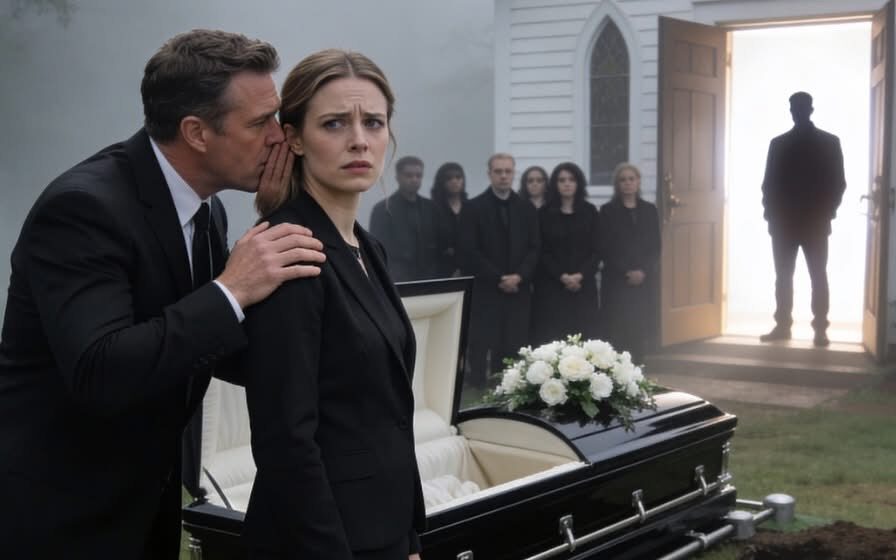
If you’ve ever stood among your own family and suddenly felt like a stranger, then you understand a kind of cold that has nothing to do with the weather.
My name is Brooke Johnson, and the day we buried my grandmother was the day grief stopped being the worst thing in the room.
The cemetery sat just outside Seattle, surrounded by tall evergreen trees that made the sky look darker than it really was. Gray clouds hung low overhead, and a sharp wind slipped through my coat like it knew exactly where to hurt.
In front of me rested the casket of my grandmother, Dorothy Johnson.
Dorothy had been the calm center of our strange family. Every afternoon she brewed tea in the same old porcelain teapot and told me patience was the most powerful weapon a person could carry.
But as the pastor finished the final prayer and people slowly walked away from the grave, something felt wrong.
My father was staring at me.
Not with grief.
With calculation.
His name was Harold Johnson, and most people described him as charming and successful. But that afternoon, there was something sharp in his expression that made my stomach tighten.
Beside him stood my stepmother, Monica Johnson, dressed in an elegant black coat.
She whispered something in his ear.
He nodded slowly.
That was the moment I felt the first crack of doubt.
⸻
The Letter in the Teapot
Later that evening, after the funeral guests had left my grandmother’s house, I walked into the quiet kitchen.
Everything looked exactly the same.
The same wooden table.
The same faded curtains.
And Dorothy’s favorite porcelain teapot sitting on the counter.
I lifted the lid.
Inside was an envelope.
My name was written across it in my grandmother’s careful handwriting.
My hands began to shake as I opened it.
The letter inside wasn’t a goodbye.
It was a warning.
“Brooke,” it began,
“If you are reading this, then I did not die naturally. And you must not trust your father or the woman living in my house.”
For a long moment I couldn’t breathe.
Everyone had assumed Dorothy died peacefully after a recent illness.
But the rest of the letter told a different story.
She believed someone had been poisoning her tea.
And she had left instructions.
⸻
The Evidence
The letter directed me to a locked cabinet in her study.
Inside I found notebooks filled with careful observations, lab test receipts, and a small flash drive.
When I opened the video file on my laptop, my entire body went cold.
The footage showed the kitchen late at night.
Then Monica walked in.
She lifted the teapot.
And quietly poured a fine white powder into it.
I whispered into the empty room,
“This can’t be real.”
At that moment my younger brother Caleb Johnson appeared in the doorway.
“What’s wrong?” he asked.
I turned the laptop toward him.
Caleb watched silently.
Then he whispered,
“Is she… poisoning Grandma?”
⸻
The Investigation
The next morning I contacted attorney Anthony Fletcher.
He listened patiently as I explained the letter, the lab reports, and the video.
Within days, the evidence was handed to detectives.
The investigation quickly uncovered more disturbing information—financial records, messages, and plans hidden inside my father’s accounts.
The motive was brutally simple.
My father believed my grandmother planned to change her will and leave most of her estate to me instead of him.
So he and Monica had decided to remove the obstacle.
Slowly.
Quietly.
Through poison.
⸻
The Trial
The trial lasted several weeks.
Every day my brother Caleb sat beside me in the courtroom.
Prosecutors explained how the poison had been added to Dorothy’s tea over time to make her illness appear natural.
When the jury finally returned their verdict, the room fell completely silent.
Guilty.
Both of them.
My father and Monica were sentenced for murder.
Relief washed over me—but it came with a heavy grief that never fully disappears.
⸻
My Grandmother’s Final Wish
After the trial, I inherited my grandmother’s home and most of her savings.
But Dorothy’s letter contained one final instruction.
She wrote:
“Money born from suffering should create safety for those who need it most.”
So instead of selling the house, I turned it into a shelter for women escaping abusive homes.
My brother Caleb helped renovate the property.
Together we built a place where people could start over safely.
⸻
When the Past Returned
For several years, life slowly settled into peace.
Until one night.
At two in the morning, the security cameras recorded someone opening the shelter’s front gate.
The figure walked halfway up the driveway before disappearing into the dark.
No sign of forced entry.
Someone had known the code.
Concerned, I hired a security specialist named Gregory Dalton.
After studying the footage, he said something that made my stomach tighten.
“Someone wanted you to know they could still reach this place.”
Not long after, we learned my father had filed an appeal.
The past wasn’t finished yet.
⸻
Moving Forward
But something had changed inside me.
Fear no longer controlled my decisions.
One evening my brother and I sat on the porch while rain drifted through the porch light.
“I keep wondering if I helped them without knowing,” Caleb admitted quietly.
I squeezed his hand.
“You were a child,” I told him.
“The people responsible were the adults who abused our trust.”
Today the shelter still operates inside my grandmother’s home.
Every person who walks through the door is another reminder of the lesson she left behind.
The truth may hide in darkness for a while.
But eventually—
someone opens the door.
And the light finds it.

Sophia Reynolds is a dedicated journalist and a key contributor to Storyoftheday24.com. With a passion for uncovering compelling stories, Sophia Reynolds delivers insightful, well-researched news across various categories. Known for breaking down complex topics into engaging and accessible content, Sophia Reynolds has built a reputation for accuracy and reliability. With years of experience in the media industry, Sophia Reynolds remains committed to providing readers with timely and trustworthy news, making them a respected voice in modern journalism.