The fall carnival at Brookfield Elementary was supposed to be one of those soft memories parents tuck away and forget until years later—paper lanterns strung across the playground, the smell of popcorn drifting through the cool air, teachers laughing in sweaters that tried too hard to be festive. It was the kind of evening that felt harmless, almost scripted in its cheerfulness.
But Sophie stayed glued to my side.
She didn’t run toward the games like she usually did. She didn’t beg for cotton candy or tug me toward the face-painting table. Her fingers twisted the fabric of my jacket like she was holding onto the last solid thing in a moving room. Every few steps, she glanced over her shoulder, as if checking whether someone was watching us.
When she finally tugged at my sleeve and whispered, “Dad, can we just go home? Please?” her voice didn’t carry impatience. It carried fear.
Inside the truck, the carnival lights faded into soft blurs across the windshield. Sophie sat with her hands folded in her lap, staring at her knees.
“I need to show you something,” she said after a long silence. “But you can’t get mad.”
That sentence alone made my chest tighten. Kids only say that when they’ve been taught that adults’ anger is more dangerous than their own pain.
“I promise,” I said quietly. “I won’t get mad. I just need to understand.”
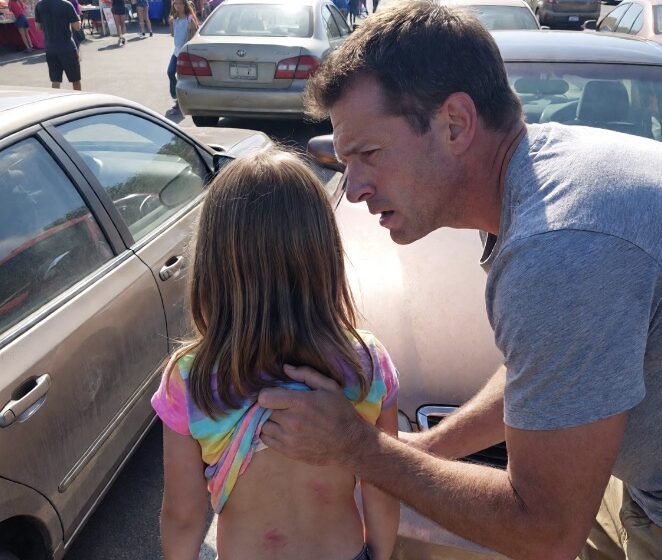
She hesitated, then slowly lifted the edge of her sweater. The marks along her side stole the breath from my lungs. They weren’t the careless bruises of playground tumbles or rough games. They were darker, more deliberate, clustered in a way that told a story my mind didn’t want to accept.
I forced my voice to stay steady. “Sweetheart… who did this?”
Her eyes filled with tears she was trying not to let fall.
“He said nobody would believe me,” she whispered. “Because he’s the principal.”
The drive to the hospital felt endless. I kept my hands steady on the wheel, because if I let myself shake, I knew she would feel unsafe. At the emergency room, the doctor spoke gently but firmly about the injuries, about mandatory reporting, about making sure Sophie was protected. The words blurred together until all I could focus on was the way Sophie gripped my hand, as if afraid that even in a room full of adults, she might still be alone.
When the officer arrived and mentioned how respected the principal was, I realized how heavy reputations can be when they’re placed on top of a child’s voice. The doubt wasn’t cruel—it was procedural—but it still felt like another door closing in Sophie’s face. That night, she slept with the light on. I stayed awake beside her, staring at the ceiling, replaying every moment I had trusted the world to be kinder than it was.
In the days that followed, I started noticing patterns I hadn’t wanted to see before. Online comments from parents whose children suddenly hated school. Teachers who transferred out quietly after “disagreements with administration.” Complaints that vanished as quickly as they appeared. No one had ever screamed about what felt wrong. Everyone had whispered. And whispering hadn’t protected anyone.
When I showed the footage I found to Ms. Caldwell, a veteran teacher known for her honesty, she didn’t look shocked. She looked relieved, like someone who had finally been given permission to stop doubting her own instincts.
“I thought I was the only one who felt something was off,” she admitted, her voice breaking. “I kept waiting for proof so I wouldn’t seem dramatic.”
That’s how these things survive—by making people feel alone in their worry.
At the school board meeting, I stood in front of a room full of parents and administrators with hands that wouldn’t stop shaking. My voice wavered, but the words came out anyway. I talked about Sophie. I talked about the marks on her side. I talked about how silence doesn’t keep the peace—it keeps harm comfortable. As I spoke, I saw other parents’ faces change. Recognition spread in small, terrible flickers.
The room didn’t turn loud all at once. It turned heavy. And in that heaviness, people finally started listening.
Justice didn’t fix what had already happened to Sophie. Therapy didn’t erase her memories overnight. Some days, she still flinched when adults raised their voices. Some nights, she still asked to sleep with the hallway light on. And I still found myself scanning rooms without meaning to, measuring exits, counting the seconds it took for her to walk back to me.
But she laughed again. Slowly. Carefully. Then more freely.
One evening, months later, we sat on the porch watching the sun dip behind the trees. She leaned her head against my shoulder and said, almost to herself, “Telling the truth is scary. But staying quiet feels worse.”
I held her a little tighter, realizing that courage isn’t loud. It doesn’t announce itself. Sometimes it’s just a small voice asking to go home—and someone finally listening.

Sophia Reynolds is a dedicated journalist and a key contributor to Storyoftheday24.com. With a passion for uncovering compelling stories, Sophia Reynolds delivers insightful, well-researched news across various categories. Known for breaking down complex topics into engaging and accessible content, Sophia Reynolds has built a reputation for accuracy and reliability. With years of experience in the media industry, Sophia Reynolds remains committed to providing readers with timely and trustworthy news, making them a respected voice in modern journalism.