On the bed, carefully spread out, lay a handmade quilt.
I stepped closer slowly, my heart beating hard in my chest.
It wasn’t an ordinary quilt. It had been stitched together from many different pieces of fabric: floral napkins, fragments of old tablecloths, bits of kitchen towels. Between every seam were narrow strips of paper sewn carefully along the edges, as if someone had tried to protect them from fading with time.
My fingers trembled as I picked up one piece.
It read:
“Vegetable soup. The first day she knocked on my door.”
Another strip said:
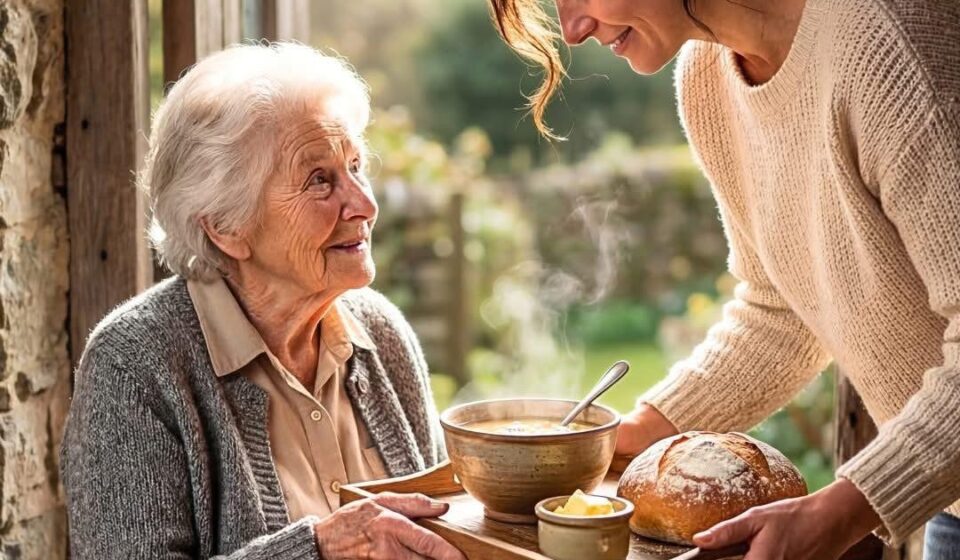
“Hot bread and tea. It was raining. She smiled and called me ‘Señora Clara.’”
Another one:
“Beans made at home. Today I didn’t feel so lonely.”
My knees nearly buckled.
The entire quilt had been created from memories of my visits.
Every square carried something small: a date, a meal, a sentence, a feeling.
For two years, Señora Clara had kept every little moment we shared as if it were something precious. As if a cup of tea or a simple plate of food was important enough to be preserved forever in fabric.
Then I noticed an envelope.
It rested on the pillow in the center of the bed, my name written across it in shaky handwriting.
For my girl from 304.
Tears were already falling as I opened it and sat on the edge of the bed.
“If you’re reading this, then I am already gone.
Forgive me for never inviting you inside. It wasn’t because I didn’t trust you. It was because I was ashamed.
Loneliness ruins the soul long before it ruins a home. And I didn’t want you to see what I had become after so many years without family, without conversation, without hugs.
You were the only person who ever knocked on my door without obligation, without expecting anything, and without rushing away.
At first I thought it would happen only once. Then I believed you would grow tired of it. Later I realized that perhaps God had sent me company exactly when I needed it most.
I saved your notes, the napkins, the little pieces of cloth, and the memory of every afternoon because I wanted to leave proof of something the world often forgets: that I still mattered to someone.
I never asked you to come inside because I was afraid of becoming too attached.
I had already buried my husband, my son, and many years ago my daughter Elena Sofia. After that, I closed my curtains—and my heart.
But you, without even knowing it, opened it again.
There were days when the soup you brought was the only meal I had. But it was always the happiest moment of my day.
There were nights when I fell asleep thinking: tomorrow she will come again.
And that thought was enough to keep me going.
Inside the nightstand drawer you will find a photograph. I want you to see it.”
My hands shook as I set the letter on my lap and opened the drawer.
Inside was an old photograph, its edges yellow with age.
It showed Señora Clara years younger, sitting on a park bench. Next to her sat a little girl about eight years old with long dark braids and a bright smile.
I froze.
The girl looked like me.
Not exactly—but enough to make my chest ache.
I returned to the letter.
“I knew it the first day I saw you in the stairwell. Of course you were not my daughter. But you had the same clear eyes. The same way of tilting your head when you listened. The same gentle way of holding things, as if everything had meaning.
That is why, perhaps selfishly, I loved you from the first bowl of soup.
Not as someone loves a neighbor.
But as someone loves a daughter who returns for a little while.
Please don’t feel frightened by these words. I don’t want to replace anyone or burden you with my sadness. I only want you to know that near the end of my life, I no longer felt abandoned.
I felt accompanied.
If you wish, keep the quilt.
It is made from the pieces of kindness you gave me.
And if you ever wonder whether small gestures matter, look at it.
A cup of tea may not change the world, but it can save an afternoon. And sometimes, my daughter, a saved afternoon is an entire lifetime.
With love,
Clara.”
I don’t know how long I sat there holding the quilt to my chest, crying as if I had lost someone from my own family.
Because in a way, I had.
While the building manager handled paperwork in the living room, I looked around the apartment with blurred eyes.
On the wall hung an old calendar filled with small blue ink marks on almost every day from the past two years.
I immediately understood.
Those were the days I had visited.
Next to every Sunday was a tiny heart.
Seeing that broke something inside me.
For me, bringing food had been a simple act—kind, yes, but ordinary.
For her, it had been the rhythm of her life. The reason to wait for the afternoon. Proof that she was not invisible.
Before leaving, I folded the letter carefully and placed it back beside the photograph.
I brought the quilt home with me.
The following weeks felt strange. Every afternoon at the same hour, my body still expected to walk down the hallway toward apartment 302 carrying a warm plate.
More than once I stopped outside her empty door.
And slowly I realized my sadness wasn’t only about her absence.
It was about everything I had never asked.
I didn’t know her favorite song.
I didn’t know which foods reminded her of childhood.
I didn’t know when the last time someone had hugged her was.
We had lived only a wall apart, yet I had known so little of her life.
That realization changed me.
I started greeting my neighbors more often.
Knocking on doors.
Asking “How are you?” and truly waiting to hear the answer.
At first it felt awkward.
Then it felt necessary.
A few months later, during a building meeting, I suggested something simple: once a week we could share a meal together in the downstairs hall, especially for those who lived alone.
No one expected much.
The first evening, five people came.
The next week, twelve.
Within two months the tables were crowded.
There was soup, rice, sweet bread, and coffee.
Older men began telling stories they hadn’t shared in years.
Widows laughed again.
Young people set their phones aside and listened.
And on a chair in the corner, I always placed Señora Clara’s quilt.
At first no one knew the story behind it.
They only said it was beautiful.
That it felt warm.
That it looked like something made with love.
And that’s exactly what it was.
Sometimes, when I finish serving food and the hall fills with conversation, I glance at the quilt quietly.
I imagine Señora Clara in her dim apartment, sewing slowly under the yellow light of a lamp, stitching together pieces of fabric the way someone tries to keep kindness from disappearing.
And I like to believe she didn’t truly die alone.
Because someone remembered her every afternoon.
Because someone spoke her name.
Because someone eventually entered her room and discovered proof that even the quietest life can hold deep love.
I still keep her letter in my nightstand.
Some nights I read it again.
And I always cry when I reach the same line:
“A cup of tea may not change the world, but it can save an afternoon.”
Since then, whenever I cook too much food, I don’t think of it as leftovers.
I think that somewhere behind a nearby door, there might be a heart simply waiting not to feel alone.

Sophia Reynolds is a dedicated journalist and a key contributor to Storyoftheday24.com. With a passion for uncovering compelling stories, Sophia Reynolds delivers insightful, well-researched news across various categories. Known for breaking down complex topics into engaging and accessible content, Sophia Reynolds has built a reputation for accuracy and reliability. With years of experience in the media industry, Sophia Reynolds remains committed to providing readers with timely and trustworthy news, making them a respected voice in modern journalism.