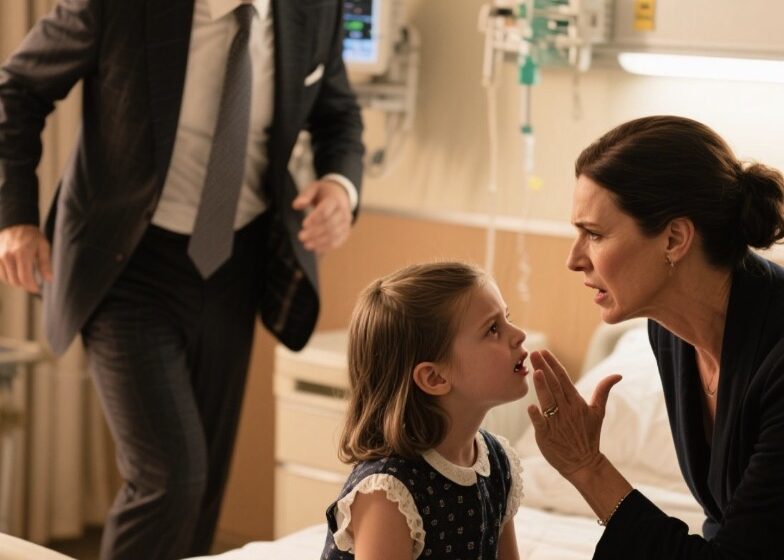
The call came at 6:02 a.m.
The sky was still dark, winter light barely breaking through the glass towers downtown. I was sitting in my SUV outside my office building, reviewing numbers on my tablet. Expansion forecasts. Profit margins. Another acquisition.
I remember feeling productive.
In control.
Then my phone lit up.
Northbridge Children’s Medical Center.
The air inside the car suddenly felt thin.
At forty-one, I had built my reputation on composure. Investors trusted me because I didn’t panic. Employees respected me because I made decisions quickly.
But when I answered that call, I wasn’t a CEO.
I was a father.
“Mr. Whitaker?” the nurse asked gently.
“Yes.”
“Your daughter Emily was admitted twenty-five minutes ago. She’s in serious condition. You need to come immediately.”
Serious condition.
The words didn’t make sense. Emily was eight. Small. Soft-spoken. She still slept with the nightlight on.
I drove without remembering the drive.
Three years earlier, after her mother died from a long illness, Emily changed. She grew quieter. Teachers said it was grief. Normal. Temporary.
I believed them.
Instead of conversations, I offered structure. Instead of comfort, I offered stability. I worked longer hours. Secured bigger contracts. Built a larger safety net.
I told myself I was doing it for her.
That was around the time Vanessa entered our lives.
Vanessa Carter was organized, calm, efficient. She kept the house spotless. Packed lunches with precision. She attended school meetings when I couldn’t.
“She needs routine,” I would say.
When we married a year later, I thought I had repaired what was broken.
I didn’t notice Emily stopped running to hug me when I came home.
I didn’t question why she wore long sleeves in warm weather.
I didn’t see that she always looked at Vanessa before answering simple questions.
I thought she was healing.
I was wrong.
At the hospital, the scent of antiseptic burned my lungs. The receptionist’s expression shifted the moment I said Emily’s name.
“Pediatric Intensive Care,” she said quietly.
Intensive care.
A doctor met me outside the room.
“She’s stable,” he said. “But she’s in significant pain.”
When I stepped inside, I nearly collapsed.
Emily looked impossibly small against the white sheets.
And her hands—
They were wrapped in thick bandages. Elevated carefully on pillows.
“Daddy?” she whispered.
I sat beside her, terrified to touch her.
“I’m here,” I said.
Her eyes filled with tears.
“Please don’t let her come in.”
“Who, sweetheart?”
She swallowed hard.
“Vanessa.”
Something cold moved through my chest.
“What happened?”
Emily’s voice trembled. She glanced toward the door as if expecting someone to appear.
“She said I needed to learn.”
“Learn what?”
“To be better.”
The words came in pieces.
How the pantry was kept locked during the day.
How food was “earned.”
How mistakes were “corrected.”
Then she said the sentence that will echo in my mind for the rest of my life.
“She made me put my hands under hot water,” Emily whispered. “She said I needed to understand what mistakes feel like.”
I couldn’t breathe.
“She said if I told you,” Emily continued softly, “you wouldn’t believe me. She said you were too busy.”
Too busy.
That broke something in me.
I took her face gently in my hands.
“I believe you,” I said. “I believe every word.”
Medical staff had already documented the injuries.
They were not accidental.
When Vanessa arrived, she looked annoyed more than concerned.
“This is exaggerated,” she said quickly. “Emily is sensitive.”
“You burned her,” I said.
“I was teaching discipline.”
A police officer stepped forward.
“Ma’am, we have sufficient evidence to proceed.”
As the handcuffs closed around her wrists, Vanessa looked at me with something close to contempt.
“You can’t handle this alone,” she said.
Maybe she was right.
But I knew one thing.
I would never fail my daughter like that again.
The weeks after were quiet and heavy.
Emily hid crackers under her pillow at night.
So I filled every cabinet in the kitchen and removed every lock.
“There will always be food,” I told her. “You never have to earn it.”
One evening she spilled juice and burst into tears.
I knelt beside her.
“Accidents don’t make you bad,” I said. “We just clean them up.”
She stared at me as if I’d spoken a foreign language.
Slowly, she stopped checking the hallway before bed.
Slowly, the nightlight became optional.
Within two months, I stepped down from my executive position. I sold the house that held too many shadows.
We moved into a smaller home with open shelves and sunlight in every room.
Months later, when the burns faded into pale scars, Emily studied her hands.
“Do they look strange?” she asked.
I kissed each mark.
“They look like proof,” I said. “Proof that you survived.”
She leaned into me.
“I love you, Dad.”
That 6:02 a.m. call didn’t destroy my life.
It revealed it.
I had spent years building security.
What my daughter needed was presence.
And I will never confuse the two again.

Sophia Reynolds is a dedicated journalist and a key contributor to Storyoftheday24.com. With a passion for uncovering compelling stories, Sophia Reynolds delivers insightful, well-researched news across various categories. Known for breaking down complex topics into engaging and accessible content, Sophia Reynolds has built a reputation for accuracy and reliability. With years of experience in the media industry, Sophia Reynolds remains committed to providing readers with timely and trustworthy news, making them a respected voice in modern journalism.