The Call That Wasn’t Supposed to Happen
The dispatcher had answered thousands of emergency calls in his career. Most were chaotic—voices shouting over one another, crying, sirens in the background. Some were hoaxes. Some were misunderstandings. Some were real emergencies that unfolded in terrifying clarity.
But this one was different.
The voice on the other end was barely above a whisper.
“Help… my parents… they—”
The line crackled. The child’s breathing came in short, shallow gasps, like he was afraid even the sound of inhaling might give him away.
Then a man’s voice cut in, sharp and furious.
“Who are you talking to? Give me the phone!”
The connection went dead.
For half a second, the room was silent.
Then the dispatcher’s training kicked in.
He slammed the location trace button, already calling out to his partner to initiate a priority response. The system locked onto a residential address in a quiet suburban neighborhood. No history of emergency calls from that house. No flagged alerts.
But the boy’s voice echoed in the dispatcher’s head.
Not just fear.
Calculation.
The child had whispered, not cried. He’d chosen the moment carefully. He knew he was in danger.
And the dispatcher knew one thing for certain:
If that boy had been caught making the call, time was not on his side.
Racing Against a Clock No One Could See
Two patrol units were dispatched immediately. Sirens off. Lights low. They didn’t want to announce themselves before they understood what they were walking into.
As the officers drove, the dispatcher replayed the audio clip again and again. He slowed it down, isolating background noise. There was a faint thud in the distance—possibly a door closing. The muffled scrape of something heavy being dragged.
The address resolved to a neat two-story house on a quiet street lined with maple trees and trimmed hedges. The kind of place where kids rode bikes in circles and neighbors waved while collecting mail.
The kind of place no one would suspect.
The patrol cars rolled to a stop at the curb. Everything looked ordinary. The lawn was freshly mowed. Flowerbeds bloomed along the walkway. The porch light was off. Curtains drawn.
Too quiet.
The officers exchanged a glance.
“Let’s knock first,” one of them murmured, already stepping out.
They approached the door, hands near their radios. One officer knocked firmly.
No response.
He knocked again.
The door creaked open.
The Child in the Hallway
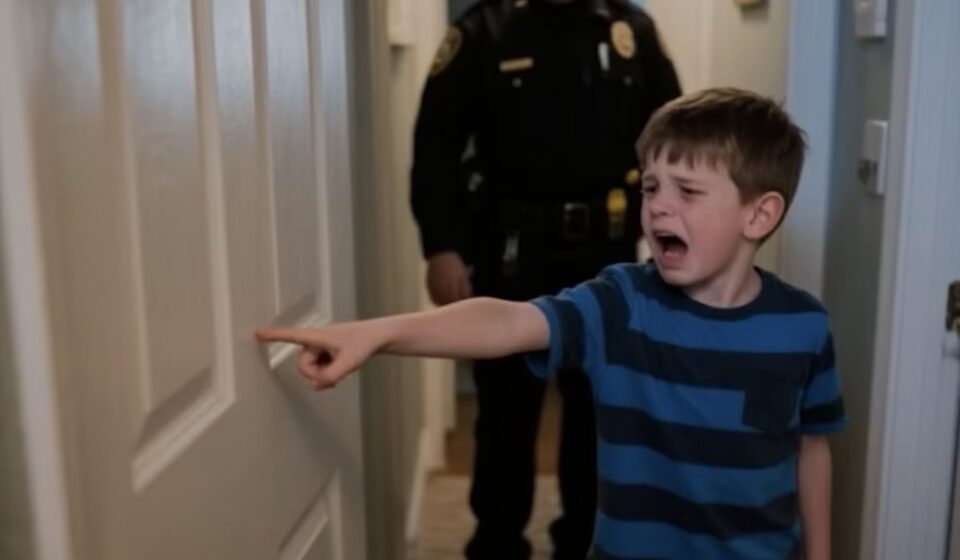
A boy stood in the doorway.
He looked about seven years old. His hair was neatly combed. His shirt was clean. No visible bruises. No tears. He held his hands together at his waist, fingers pressed tight.
But his eyes told a different story.
They were wide. Alert. Heavy with a seriousness no child should carry.
“Hey there,” the officer said gently. “Were you the one who called?”
The boy nodded once.
He didn’t speak.
He stepped aside and pointed down the hallway toward a half-open door.
“My parents,” he whispered.
The second officer stayed close to the boy, lowering himself to the child’s height. “You did the right thing,” he said softly. “You’re safe now, okay?”
The boy didn’t move. He leaned against the wall, eyes locked on that door.
The first officer drew his weapon and advanced down the hall.
The Room Where Time Stopped
The hallway felt longer than it should have. Each step seemed to echo too loudly. The officer placed a hand on the doorframe and pushed the door open inch by inch.
Inside, a man and a woman sat bound to chairs with plastic zip ties. Tape covered their mouths. Their eyes were wide, frantic, desperate to speak.
Standing over them was a man in a black hoodie.
In his hand: a knife.
For a split second, all three froze.
Then training took over.
“Police!” the officer shouted. “Drop the weapon! Now!”
The intruder’s eyes flicked toward the hallway. Toward the boy. Toward the badge. His grip tightened. The knife trembled.
“Now!” the officer repeated, voice steady but thunderous.
The second officer rushed in, placing himself between the boy and the room, one arm shielding the child behind him.
The moment stretched, taut as wire.
Then the knife slipped from the intruder’s fingers and clattered to the floor.
The man dropped to his knees.
Within seconds, he was restrained, cuffed, and disarmed. The parents were freed. The mother sobbed into her son’s shoulder, clutching him so tightly the officers had to gently remind her to breathe.
The father’s hands shook as the tape was peeled from his mouth.
“Thank you,” he whispered. “Thank you.”
What the Boy Had Done
Later, as the house filled with backup officers and paramedics, the dispatcher who took the call listened to the outcome over the radio.
The intruder had broken in hours earlier, tying up the parents at knifepoint. He hadn’t expected a child. When he noticed the boy hiding near the stairs, he’d dismissed him as too small to be a threat. He’d ordered the child to stay in his room.
The boy obeyed.
But only on the surface.
He waited until the intruder turned his back. He crept into the hallway. He dialed 911 and whispered just enough to get help on the way.
He didn’t cry.
He didn’t scream.
He calculated.
That single decision saved his parents’ lives.
The Weight a Child Shouldn’t Carry
A sergeant knelt in front of the boy after the intruder was taken away.
“You were unbelievably brave,” he said. “You saved your mom and dad.”
The boy nodded, eyes fixed on the floor.
“I was scared,” he whispered.
“That’s what bravery is,” the sergeant said. “Being scared and doing the right thing anyway.”
Later, child services arrived to arrange counseling and support. The parents were treated for shock and minor injuries. The boy was wrapped in a blanket and given a juice box he didn’t touch.
He sat between his parents, holding both their hands.
The dispatcher finally allowed himself to exhale.
He replayed the call one last time.
Help, my parents…
The line going dead.
That whisper had traveled through wires and systems and radios to reach the right people in time.
One child’s quiet courage had cut through the silence.
The Mistake That Changed Everything
Investigators would later say the intruder’s fatal error was underestimating a child.
He saw smallness and assumed helplessness.
He saw quiet and assumed compliance.
He never considered that the smallest voice in the house might be the one that carried far enough to bring the world crashing down on him.
That mistake saved two lives.
And gave a seven-year-old a story he would carry forever.

Sophia Reynolds is a dedicated journalist and a key contributor to Storyoftheday24.com. With a passion for uncovering compelling stories, Sophia Reynolds delivers insightful, well-researched news across various categories. Known for breaking down complex topics into engaging and accessible content, Sophia Reynolds has built a reputation for accuracy and reliability. With years of experience in the media industry, Sophia Reynolds remains committed to providing readers with timely and trustworthy news, making them a respected voice in modern journalism.