It began on an ordinary weekday morning in a quiet neighborhood outside Tacoma, Washington.
The kind of place where neighbors wave politely across their lawns, yet most people keep their personal lives carefully hidden behind closed doors.
I had stepped outside to collect the mail when my neighbor, Eleanor Whitaker, called my name.
She stood beside her rose bushes, holding a pair of gardening shears and wearing an expression that made me uneasy before she even spoke.
“Lydia,” she said carefully, walking toward the mailbox. “I hope you don’t take this the wrong way… but I think you should know something.”
I smiled politely, expecting a comment about the weather or the next neighborhood meeting.
Instead, she said something that made my stomach tighten instantly.
“I’ve seen your daughter at home during school hours this week.”
For a moment, I thought I had misunderstood.
My daughter Hannah Miller was twelve years old—responsible, organized, and praised constantly by teachers for her maturity.
Every morning she left the house at exactly 7:20 to catch the bus.
“That can’t be right,” I said with a small laugh. “She goes to school every day. I watch her walk to the corner.”
Eleanor hesitated.
“I thought maybe I was mistaken,” she admitted. “But yesterday afternoon I saw her upstairs in your house. She was standing by the window in her bedroom.”
A quiet uneasiness settled in my chest.
Hannah didn’t skip school.
She was the type of child who worried about disappointing people—even when no one expected perfection from her.
But as I walked back into the house, Eleanor’s words refused to leave my mind.
Watching for Something I Couldn’t See
That evening I paid closer attention to Hannah.
She sat at the kitchen table finishing math homework, occasionally humming while solving problems far more complicated than anything I remembered from my own childhood.
At dinner she told me about a science project involving plant growth.
Later we even laughed together while watching a silly video of a dog chasing soap bubbles.
Everything seemed perfectly normal.
And yet… the uneasiness remained.
That night, after she went upstairs, I stood in the hallway listening to the quiet sound of pages turning in her room.
Nothing about the moment suggested a secret.
But the feeling lingered.
The Decision That Felt Wrong
The next morning Hannah followed her usual routine.
She ate cereal while reading a few pages from a paperback novel.
At exactly 7:20 she grabbed her backpack.
“See you this afternoon, Mom,” she said before hugging me quickly.
“Have a good day,” I replied.
I watched her walk down the driveway toward the bus stop.
Then I did something I had never done before.
Instead of driving to work in Tacoma, I circled the block and parked behind a row of tall hedges where the car wouldn’t be visible.
Then I quietly entered the house through the side door.
The silence inside felt strangely heavy.
I walked upstairs.
Hannah’s bedroom door was closed.
When I opened it, the room looked exactly as it always did.
Her bed was neatly made.
Her desk organized.
Morning sunlight filtered through the curtains.
Still, my hands trembled slightly.
After a moment of hesitation, I did something that felt almost ridiculous.
I lowered myself to the floor and slid under the bed.
Dust tickled my nose as I waited in the narrow space.
At first there was only silence.
Then I heard footsteps.
The Voices That Changed Everything
The footsteps climbed the stairs slowly.
The bedroom door creaked open.
Another set of footsteps followed.
Then two voices began speaking.
One belonged to Hannah.
The other voice belonged to someone I recognized immediately.
Nathaniel Porter, the guidance counselor from Hannah’s school.
My heart began pounding.
“I told you we can’t keep doing this without telling your mom eventually,” Mr. Porter said gently.
Hannah’s voice sounded fragile.
“Please… not yet.”
A heavy feeling filled my chest.
“Hannah,” he continued softly, “you can’t leave school and come home alone without anyone knowing. It isn’t safe.”
She inhaled shakily.
“Sometimes when I’m sitting in class… it feels like the room is closing in,” she whispered. “Like I can’t breathe.”
Silence followed.
Then Mr. Porter spoke carefully.
“What you’re describing sounds like panic attacks. And there’s nothing shameful about that.”
Panic attacks.
The words hit me like a shock.
I had never imagined my daughter was struggling with something like that.
Her voice trembled.
“Every morning before school I feel sick,” she admitted. “My heart starts racing and I keep thinking something terrible will happen in class.”
I closed my eyes beneath the bed, overwhelmed.
While I believed everything was fine, my daughter had been quietly fighting fear every single day.
“When you called me last week,” Mr. Porter said gently, “I could hear how scared you were. That’s why I came.”
Hannah sniffed softly.
“Please don’t tell my mom yet,” she whispered. “She works so hard… I didn’t want her to think I was weak.”
Stepping Out of the Silence
A few minutes later Mr. Porter stood to leave.
“I’ll give you some time to think,” he said. “But I really believe we should talk to your mom together.”
“Okay,” Hannah replied quietly.
The door closed.
The house fell silent again.
I realized if I stayed hidden any longer, my daughter would continue believing she had to face this alone.
Slowly, I slid out from beneath the bed.
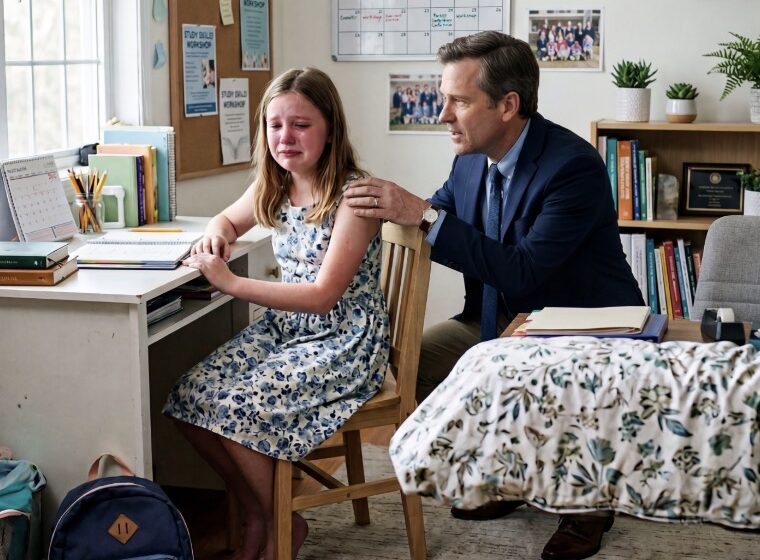
Hannah sat on the edge of the mattress, shoulders hunched, hands clasped tightly.
When she saw me standing there, her eyes widened.
For a moment neither of us spoke.
Then her face crumpled.
“Mom… I’m sorry.”
The apology broke my heart.
I crossed the room and wrapped my arms around her.
“You have nothing to apologize for,” I whispered. “If anyone should be sorry, it’s me—for not realizing how much you were hurting.”
She trembled against me.
“I didn’t want to worry you,” she said softly. “Everyone says I’m the responsible one.”
I looked into her eyes.
“Being scared doesn’t mean something is wrong with you,” I told her gently. “It means you’re human. And you deserve help.”
“You’re not angry?” she asked.
I shook my head.
“I’m just sad you felt like you had to carry this alone.”
Learning to Face It Together
Later that afternoon Mr. Porter joined us at the kitchen table.
Sunlight streamed through the window as we talked openly about what Hannah had been experiencing.
He explained that anxiety and panic episodes are common among students who put intense pressure on themselves to succeed.
He also described ways to help.
Hannah could step out of class briefly when she felt overwhelmed.
Counseling sessions could help her manage the racing thoughts that appeared each morning.
Most importantly, she would no longer have to hide what she was feeling.
As we talked, I noticed something change.
The tension slowly left her shoulders.
Simply speaking about the fear made it feel less powerful.
Before leaving, Mr. Porter smiled gently.
“The most important thing,” he said, “is that you face this together.”
Hannah nodded quietly.
That night she went upstairs and left her bedroom door open for the first time in months.
I sat in the hallway for a while, listening to her steady breathing as she fell asleep.
And I realized something many parents learn only after a moment of painful clarity.
The most important struggles in a child’s life are not always visible.
Sometimes the quietest children are carrying the heaviest worries.
And the strongest thing they can do…
is finally let someone see them.

Sophia Reynolds is a dedicated journalist and a key contributor to Storyoftheday24.com. With a passion for uncovering compelling stories, Sophia Reynolds delivers insightful, well-researched news across various categories. Known for breaking down complex topics into engaging and accessible content, Sophia Reynolds has built a reputation for accuracy and reliability. With years of experience in the media industry, Sophia Reynolds remains committed to providing readers with timely and trustworthy news, making them a respected voice in modern journalism.