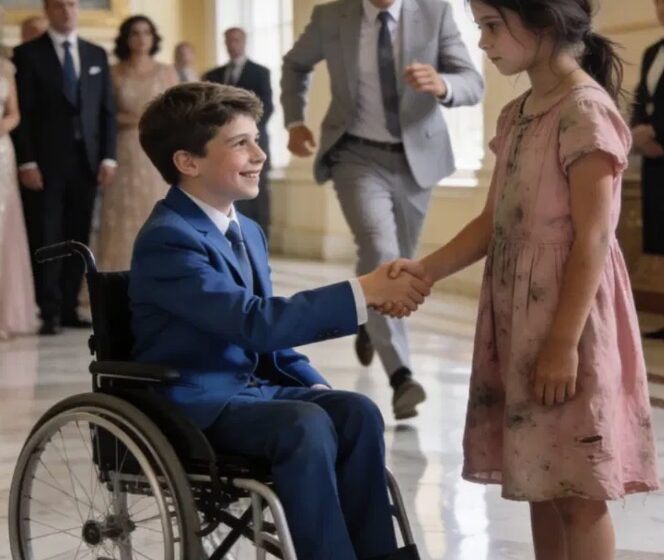
To the outside world, Michael Harrison had everything.
Founder of one of the most powerful investment firms on Wall Street. A glass-and-steel mansion in the Hamptons that overlooked the Atlantic like a private empire. His calendar was booked months in advance. His name opened doors before he even arrived.
But inside that mansion, there was a silence money couldn’t touch.
His seven-year-old son, Ethan, hadn’t taken a single step since the accident that killed his mother.
The crash had made headlines. Reporters crowded hospital entrances. Analysts speculated about how long Michael would disappear from the markets.
No one asked how long a child could disappear into himself.
At Johns Hopkins Hospital, specialists ran scan after scan. At Mayo Clinic, neurologists studied his brain activity.
MRIs were clean. Nerve responses normal. Muscle strength intact.
The diagnosis was as frustrating as it was intangible:
Psychological trauma.
“There is no physical reason he can’t walk,” one doctor told Michael gently. “But his body is protecting him from something.”
Protecting him from grief.
From memory.
From the moment everything shattered.
So Ethan stayed in his wheelchair. Silent. Watching the world move without him.
The Girl Who Didn’t Flinch
One humid afternoon in Central Park, Ethan’s therapist suggested exposure therapy.
“Let him see children his age,” she said. “Let him feel life again.”
Michael pushed the wheelchair down a sunlit path. Kids sprinted through sprinklers. A little boy tripped, scraped his knee, and got back up laughing.
Michael’s chest tightened.
He would trade every stock, every property, every award—
For one scraped knee.
Then she appeared.
Barefoot. Thin. Oversized hoodie slipping off one shoulder. Maybe eight years old. Tangled curls and fearless eyes.
She walked straight up to Ethan.
“Hi,” she said simply.
Michael stepped forward instantly. “We’re not giving money.”
She didn’t look at him.
She looked at Ethan.
Then she said it — calm, certain, impossible:
“Let me dance with your son. I’ll make him walk again.”
Michael nearly scoffed.
The top neurologists in the country had failed. Physical therapists. Trauma experts. Private specialists flown in from three states.
And this child thought she could fix his son with… dancing?
He opened his mouth to refuse.
But Ethan spoke first.
“Dance?” he whispered.
It was the first word Michael had heard from him in weeks.
The girl smiled.
“Yeah. I’m Lily. And you look like someone who forgot your music.”
Something inside Michael hesitated.
“Five minutes,” he muttered.
Music Starts in the Heart
Lily didn’t ask for speakers.
She started humming.
A soft rhythm. Then clapping. Then tapping the sides of Ethan’s wheelchair.
“Start here,” she said, placing her hand gently over his chest. “Music begins inside. Not in your legs.”
She swayed exaggeratedly. Twirled dramatically. Made a fool of herself on purpose.
Ethan blinked.
Then his lips twitched.
Then — a sound Michael hadn’t heard since before the accident:
A laugh.
Small. But real.
Lily held out her hands.
“Upper body first,” she coached. “That’s how I helped my sister.”
The next day, she brought that sister — Sofia — quiet, observant, maybe twelve. She explained that after their mother left, Sofia had stopped walking too.
“She wasn’t broken,” Lily said simply. “She was sad.”
And dancing brought her back.
A Mansion Transformed
Within a week, Michael made a decision that shocked his staff.
The Persian rugs were rolled up.
The grand piano room became an open space.
Mirrors were installed.
The Harrison mansion — known for silent dinners and echoing hallways — filled with clapping, humming, and off-beat rhythm.
Lily came every afternoon.
At first, Ethan only moved his shoulders.
Then his arms.
Then he sat without support for ten seconds.
Twenty seconds.
One day, he pushed himself up halfway.
Michael stopped breathing.
Ethan fell back into the chair — but he was smiling.
The neurologist later admitted what he had rarely seen so clearly:
“Emotional movement is activating neural pathways we couldn’t reach clinically.”
It wasn’t just dance.
It was safety.
It was connection.
It was joy.
The Night the World Watched
Three months later, Michael hosted a charity gala in Manhattan focused on childhood trauma recovery.
Investors, celebrities, foundations — all seated beneath crystal chandeliers.
The stage curtain lifted.
A wheelchair sat alone in the spotlight.
Whispers filled the room.
Then—
Ethan stood.
Not steady. Not perfect.
But standing.
A collective gasp rippled through the audience.
Step.
Pause.
Step.
He walked to center stage, where Lily waited barefoot in a simple white dress.
The music began.
They didn’t perform choreography.
They moved freely.
Imperfect.
Beautiful.
Alive.
By the time Ethan spun — slightly off balance but upright — the audience was on its feet.
Michael didn’t clap.
He wept.
Openly.
The Real Miracle
That Christmas, the Harrison mansion felt different.
Not curated.
Not staged.
Alive.
Lily and Sofia sat at the dining table — no longer drifting between shelters. Michael had ensured they had a home, schooling, stability.
But he never called it charity.
He called it gratitude.
Ethan ran — actually ran — through the dining room, chasing Lily in circles until they collapsed laughing on the floor.
Michael raised his glass.
“To the barefoot angels,” he said quietly.
Because the real miracle wasn’t just that his son walked again.
It was that a little girl who had nothing—
Walked straight up to power…
And asked it to dance.
And sometimes, when medicine reaches its limits…
Healing begins with rhythm.

Sophia Reynolds is a dedicated journalist and a key contributor to Storyoftheday24.com. With a passion for uncovering compelling stories, Sophia Reynolds delivers insightful, well-researched news across various categories. Known for breaking down complex topics into engaging and accessible content, Sophia Reynolds has built a reputation for accuracy and reliability. With years of experience in the media industry, Sophia Reynolds remains committed to providing readers with timely and trustworthy news, making them a respected voice in modern journalism.