The sun had barely crested the low rooftops of Brighton Falls, a modest town that prided itself on tradition, order, and a carefully polished image of calm respectability. Heat arrived early that morning, pressing down on sidewalks and stone buildings as if the town itself were holding its breath. In the central square—where the old courthouse faced a weathered fountain built generations earlier—life moved in its familiar rhythm: shopkeepers opening doors, retirees lingering on benches, delivery trucks rumbling through narrow streets.
That rhythm shattered before noon.
Judge Monique Aldridge walked toward the courthouse with measured steps, her briefcase firm in her hand, her posture steady despite the quiet weight she carried every day. She was a federal judge—appointed after years of grinding work, late nights, and battles she never asked for. In courtrooms, her voice was calm and precise, her rulings unbending. On the streets of Brighton Falls, however, her presence unsettled people who believed authority should look and sound a certain way.
To some, she wasn’t a judge at all.
She was still “out of place.”
Near the fountain, several police vehicles were parked haphazardly, blocking part of the pedestrian path. A city sanitation truck idled nearby, its engine rattling the air. A cluster of officers lounged in the shade, laughing too loudly, their posture loose with the confidence of people who believed the square belonged to them.
Among them stood Sergeant Trevor Mallory.
Mallory was known around town for bravado disguised as humor. He liked attention. He liked the small power that came from making others uncomfortable. At his feet lay a coiled hose, water spilling across the pavement in a careless stream.
When he noticed Judge Aldridge approaching, his mouth twisted into a grin.
“Well, look at this,” he called out, his voice carrying across the square. “Someone dressed for a boardroom instead of real life.”
The officers around him snickered. A few bystanders slowed their steps, sensing entertainment. Judge Aldridge neither flinched nor turned away. She had learned, over years of subtle hostility, that reacting too quickly fed men like Mallory.
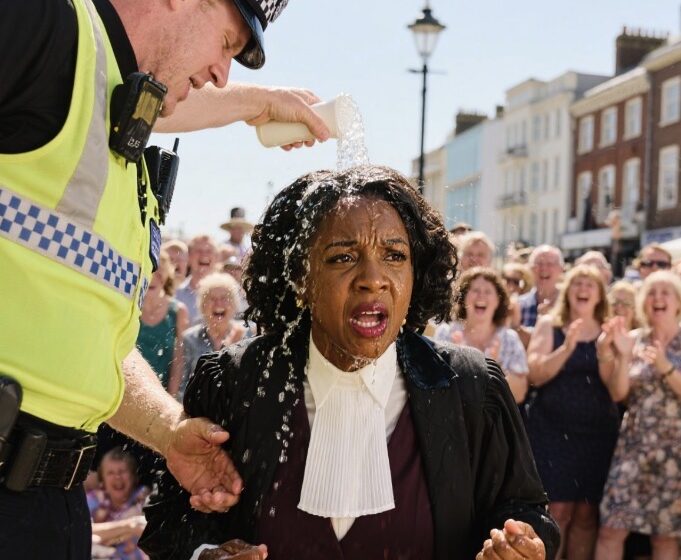
Mallory lifted the hose.
“Maybe she needs to cool off,” he said loudly. “Too much heat goes to the head.”
Before anyone could stop him—before the meaning of his words even settled—he twisted the valve.
Cold water slammed into her chest. Her blouse clung instantly to her skin. The briefcase slipped from her grasp and hit the stone with a hollow thud. For a heartbeat, the square went silent.
Then the laughter erupted.
Phones rose into the air. Some people gasped, others chuckled nervously, unsure whether to intervene. Humiliation, when packaged as “a joke,” made spectators feel safer staying still.
Judge Aldridge did not scream.
She did not run.
She did not plead.
Water streamed from her sleeves as she straightened. Her hair clung to her face. She looked directly at Mallory and slowly read the name stitched on his uniform. She noted his badge number. She registered the patrol car behind him.
Mallory stepped closer, enjoying the moment.
“What are you going to do now?” he mocked. “Call someone important?”
She bent, retrieved her briefcase, and met his gaze with unsettling calm.
“You’ve already done enough,” she said quietly.
Then she turned and walked toward the courthouse, every step deliberate, every movement watched by a crowd that suddenly felt the weight of what it had just witnessed.
The Report That Changed Everything
Inside her office, Judge Aldridge closed the door and allowed herself one long breath. Her hands trembled—not from fear, but from the effort of restraint. Then she opened a notebook.
She wrote the exact time.
The precise location.
The names of officers she recognized.
Descriptions of bystanders who had filmed the incident.
She formally requested preservation of surveillance footage from nearby businesses and city cameras. She filed a detailed complaint with internal oversight and forwarded copies to federal review boards that specialized in misconduct and civil rights violations.
Later that afternoon, her colleague Judge Samuel Corbett stepped into her office.
“Monique,” he said carefully, “you know this won’t stay quiet.”
She looked up at him. “It was never quiet. It just looked that way because people like him depend on silence.”
By evening, the footage had spread across local networks and private group chats. Some comments mocked her. Others expressed outrage. Many revealed how accustomed the town had become to watching people be humiliated in public.
Then someone said what changed everything:
“That’s Judge Aldridge. She sits on the federal bench.”
The tone shifted instantly.
The Officer Who Thought He Was Untouchable
Mallory’s laughter evaporated. He hurried to his commanding officer, Captain Harold Benton, demanding reassurance.
“It was nothing,” Mallory insisted. “A stupid joke.”
Benton’s jaw tightened. “You don’t talk to anyone. Not your union. Not your friends. Not the press.”
Behind closed doors, quiet panic spread. Calls were made. Whispers circulated. A few people tried to soften statements. Others suddenly “forgot” details.
It didn’t matter.
Prosecutor Vanessa Greene took the case personally. She subpoenaed footage, requested communications, and called witnesses who had never been asked for their version of events.
A municipal worker, Renee Whitfield, came forward, hands shaking.
“He aimed first,” she testified. “He said he wanted to make her feel small.”
A shop owner provided audio that left no room for interpretation.
When the recording played during the hearing, Mallory’s own voice echoed through the room:
“I wanted to humiliate her. I did it because I could.”
The silence that followed felt heavier than any shout.
When asked to respond, Mallory stared at the table. “I thought I was untouchable,” he admitted. “I was wrong.”
Consequences
The ruling was swift.
Mallory was terminated for abuse of authority and conduct unbecoming of an officer.
A criminal investigation was opened.
Captain Benton was removed pending review for failure of oversight.
Brighton Falls gathered again in the square days later—this time with microphones, not laughter. People spoke about things they had swallowed for years: small humiliations, unchecked behavior, moments they’d told themselves “weren’t worth the trouble.”
Judge Aldridge stood among them, not as a symbol, but as a listener. She knew what had happened to her was one ripple in a much larger storm.
That night, as she turned off her office light, she felt no triumph. Only resolve.
Once respect is demanded in the open, it doesn’t retreat quietly.
And Brighton Falls would never again pretend nothing happened in its square.

Sophia Reynolds is a dedicated journalist and a key contributor to Storyoftheday24.com. With a passion for uncovering compelling stories, Sophia Reynolds delivers insightful, well-researched news across various categories. Known for breaking down complex topics into engaging and accessible content, Sophia Reynolds has built a reputation for accuracy and reliability. With years of experience in the media industry, Sophia Reynolds remains committed to providing readers with timely and trustworthy news, making them a respected voice in modern journalism.