She Shared Half of Her Only Meal With a Stranger at a Cemetery—Days Later, a Will Changed Both Their Lives Forever

In Savannah—where Spanish moss drapes from old oak branches like soft green curtains, and tourists wander past historic homes clutching iced coffee—there lived a little girl who didn’t walk for leisure.
She walked from habit.
From necessity.
From loyalty.
Her name was Emily Carter. She was ten years old, and she had none of the things people usually mean when they say the word home.
No father.
No mother.
No bedroom.
No bed.
What she did have was a gray sweater with two holes at the sleeves, a ripped backpack with one strap tied in a knot, and a quiet, stubborn courage she never spoke about—because to her, courage was just what you used when there were no other tools left.
After her mother, Laura, died in a public hospital months earlier, Emily learned how to disappear into the corners of the city. Some nights she slept beneath the awning of a closed bookstore. Other nights, she curled up on a park bench near the river, where the water smelled faintly of rust and salt. Once, she slept in the doorway of an apartment building where the night guard pretended not to see her as long as she stayed quiet and small.
She bathed when the rain came.
She learned to braid her hair unevenly so it wouldn’t knot.
She learned which store owners would let her use the bathroom and which ones would threaten to call the police.
She learned to read faces—who might help, who might hurt.
She learned to run when adults smiled too warmly.
Every single day, at exactly five in the afternoon, Emily followed the same routine.
She walked to the St. Jude Community Kitchen, a modest brick building that smelled of beans, bleach, and something that felt like hope if you were hungry enough. Local volunteers handed out one hot meal per person in white foam containers. Sometimes it was rice and soup. Sometimes chicken, if donations were good. Sometimes just bread and stew, thin but warm.
Emily always asked for just one portion.
One.
The only meal she could count on that day.
And still—every single day—
she divided it in two.
She pressed the warm container to her chest as if it were something precious, crossed two narrow streets, then the main road, then a small bridge where cars roared past her too close. She followed a dirt path that curved toward Oak Hill Cemetery. The iron gate groaned when she pushed it open, and inside, the world changed.
The noise fell away.
The air cooled.
Cypress trees stood like quiet witnesses.
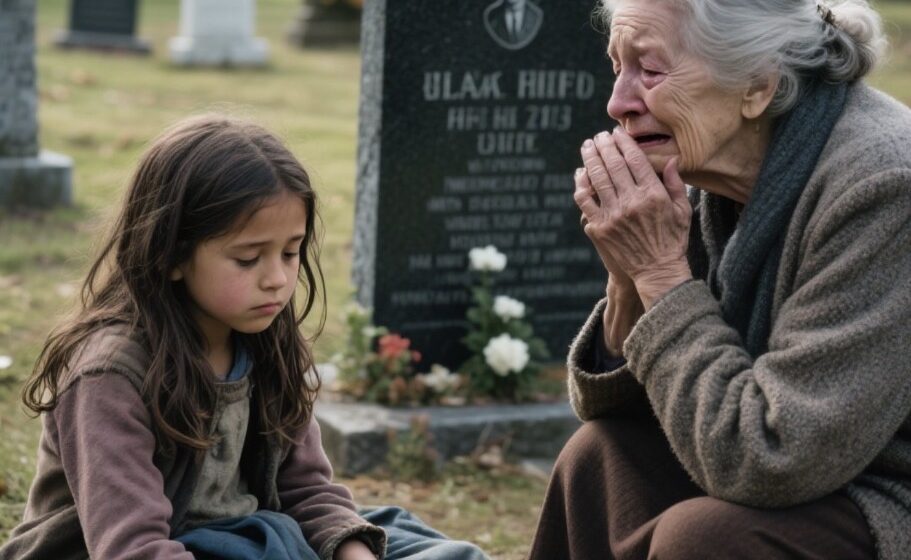
There, always in the same spot, on the same cracked concrete bench before a modest headstone, sat Margaret Wilson.
Margaret wore her white hair in a tight bun that never loosened, even in the humidity. Her sandals were worn thin at the soles. Her wool sweater smelled faintly of cheap soap. Her eyes looked like they had been crying for so long they’d forgotten how to stop.
She came every day to talk to the man buried there—Henry Wilson, her husband of forty-two years.
At first, Emily only watched from a distance. She had learned that adults could be dangerous, even when they looked broken. But one evening, driven by a courage she didn’t recognize as bravery, she walked up with the foam container in both hands.
“Are you hungry?” Emily asked, offering it the way other children might offer a toy.
Margaret looked up. She saw the dirty knees, the knotted backpack strap, the too-thin sweater. But what struck her hardest was the loneliness that sat on the girl’s shoulders like a weight she had been carrying for years.
“And you, sweetheart?” Margaret asked. “Aren’t you going to eat?”
Emily shrugged.
“We’ll split it.”
She opened the container carefully, placing half the rice, beans, and chicken into the lid. They ate quietly as the evening breeze moved through the graves.
No questions.
No demands.
Just food and the sound of breathing.
“I’ll be back tomorrow,” Emily said when she stood to leave.
And she was.
Days turned into weeks. Silence softened into conversation.
Margaret talked about Henry—how he whistled while he worked construction, how he always came home dusty and smiling, how he once walked three miles in the rain just to bring her a single daisy because she’d looked sad that morning. They were never wealthy. They counted pennies. Paid rent late. But Henry never let her forget she was loved.
“He was my whole world,” Margaret whispered one evening. “And now I don’t know why I’m still here.”
Emily listened with a seriousness that didn’t belong to a ten-year-old. Sometimes she held Margaret’s hand. Sometimes she just sat beside her. Some pain didn’t need fixing—just witnessing.
In time, Margaret began to listen too.
Emily told her about her mother, Laura. About how she got sick too fast. About how the hospital smelled like metal and fear. About waiting on the floor outside the room because children weren’t allowed inside, hugging her empty backpack like it was alive.
“I know my mom’s in heaven,” Emily said once, pressing a small hand to her chest. “But it still hurts here.”
Margaret pulled her close then. Tight. As if she could hold grief in place if she squeezed hard enough.
Without planning it, they became family.
Family built on a cracked bench and shared meals.
Family stitched together by loss.
A chosen family.
Until one ordinary afternoon stopped being ordinary.
Emily arrived with the warm container tucked under her arm. The sun turned the trees gold. But before she reached the bench, she heard voices.
Men’s voices.
Three men in dark suits stood beside Margaret. Leather briefcases rested at their feet, polished shoes sinking slightly into the dirt. One spoke gently, but his eyes were sharp.
“Mrs. Wilson,” he said, “you are the sole legal heir.”
Emily froze.
The man opened his briefcase and spread papers across the bench. “Your husband left a registered will. There is an inheritance in your name—several million dollars. Along with a property in one of the city’s most exclusive neighborhoods.”
“That’s impossible,” Margaret whispered. “Henry was a construction worker. We had nothing.”
“Years ago, he received an inheritance from a distant relative,” the lawyer explained. “He chose a simple life. The waiting period has ended.”
Emily dropped the container without realizing and rushed forward, gripping Margaret’s hand.
“Are you okay, Grandma Margaret?”
Margaret broke down, right there in the cemetery.
“I don’t know what to do, my love.”
They spoke of paperwork and houses and signatures. Margaret was guided away. She promised, “I’ll come back tomorrow.”
She didn’t.
Emily returned the next day.
And the next.
And the next.
Her fingers grew numb holding the edge of the bench.
Meanwhile, Margaret wandered through a mansion that felt like a museum of someone else’s life. Marble floors echoed her footsteps. Chandeliers glittered. Closets overflowed with clothes that didn’t feel like hers. Every room felt too big. Too loud with emptiness.
“I don’t want this without her,” she told the lawyers. “Help me find the child. Or I don’t want any of it.”
A week later, she went back to the cemetery.
Same sweater.
Same bun.
Same sandals.
Emily ran into her arms.
“I thought you weren’t coming back.”
“I was fixing something important,” Margaret said. “I want you to live with me. I want to be your grandmother for real.”
Emily’s voice was barely a breath.
“Yes.”
Three months later, the adoption was finalized.
Emily Carter became Emily Wilson.
She had a bed. A desk. School supplies. A future.
But Margaret’s most treasured possession wasn’t in the mansion. On a shelf in the kitchen sat a washed foam container.
“This brought us together,” she said. “It’s worth more than all of this.”
Every week, they returned to the community kitchen—to serve.
Emily smiled at lonely children the way someone once smiled at her.
Sometimes she opened her own container.
And said softly:
“We’ll split it.”
Because sometimes, the greatest inheritance isn’t money.
It’s being seen.
Sophia Reynolds is a dedicated journalist and a key contributor to Storyoftheday24.com. With a passion for uncovering compelling stories, Sophia Reynolds delivers insightful, well-researched news across various categories. Known for breaking down complex topics into engaging and accessible content, Sophia Reynolds has built a reputation for accuracy and reliability. With years of experience in the media industry, Sophia Reynolds remains committed to providing readers with timely and trustworthy news, making them a respected voice in modern journalism.