The Sound That Didn’t Belong
The sliding glass doors of St. Matthew Regional Hospital opened early on a quiet gray morning, letting in a rush of cool air and a strange, uneven sound.
At first, the receptionist assumed it was just a faulty supply cart.
The noise echoed across the lobby—metal scraping against tile, wheels protesting loudly as if they hadn’t turned properly in years.
But the sound didn’t stop.
It grew closer.
Slower.
Heavier.
Finally, the receptionist looked up.
Her hands froze above the keyboard.
A small girl stood just inside the entrance.
She couldn’t have been older than seven.
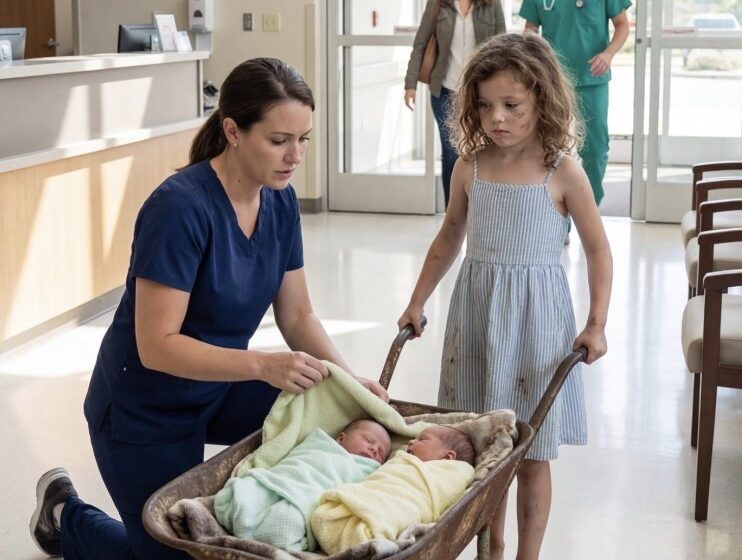
Her bare feet were dark with dirt and dust, tiny cuts marking the bottoms as if she had walked miles over gravel. Her faded dress hung stiff with mud, and both hands clutched the wooden handles of a rusted wheelbarrow.
The metal frame shrieked each time it moved.
Inside the wheelbarrow, wrapped in a thin bedsheet, lay two infants.
They were so still that for a terrifying moment no one in the lobby could tell if they were breathing.
The girl swallowed hard.
“Please,” she whispered, her voice dry from exhaustion.
Several nurses turned toward her.
“My brothers won’t wake up.”
The entire lobby fell silent.
The Nurse Who Ran First
Emergency nurse Margaret Collins reacted before anyone else.
Twenty years in emergency medicine had taught her one rule: when something feels urgent, you move first and ask questions later.
She rushed forward and knelt beside the wheelbarrow.
“Sweetheart,” she said gently, lifting one of the infants into her arms. “Where is your mother?”
The little girl’s eyes were steady despite the exhaustion in them.
“She’s sleeping,” the girl said quietly.
“For how long?”
“Three days.”
A cold tension passed through the room.
Margaret felt the baby’s skin. It was colder than it should have been.
“How long have they been quiet?” she asked.
The girl’s shoulders trembled slightly.
“I think since yesterday.”
Within seconds the hospital staff moved into action.
Doctors rushed the babies toward the neonatal unit while Margaret stayed beside the child.
“What’s your name?” she asked softly.
“Emma.”
“Emma… where did you come from?”
The girl looked unsure how to explain.
“The blue house past the broken bridge,” she said. “Near the old grain silo.”
Margaret exchanged a quick glance with another nurse.
That location was miles away.
Emma tightened her grip on the wheelbarrow.
“I need to go with them,” she said firmly. “I promised my mom I’d save them first.”
Margaret placed a reassuring hand on the girl’s shoulder.
“You already did,” she said.
Emma opened her mouth to reply.
But suddenly the strength left her body.
Her knees buckled.
Margaret caught her before she hit the floor.
The House Past the Bridge
While doctors worked to stabilize the infants, Sheriff Daniel Ramirez drove toward the rural farmland Emma had described.
The road narrowed into a stretch of cracked gravel surrounded by quiet fields.
Eventually he reached a leaning blue farmhouse that looked as though time had been slowly pushing it toward the ground.
Inside, paramedics discovered Emma’s mother, Laura Carter, lying weakly on a mattress in the living room.
She was alive—but barely.
Doctors later determined she had given birth to twins at home several days earlier and had lost dangerous amounts of blood before collapsing.
But the detail that struck the sheriff most sat quietly on the kitchen table.
A small notebook.
Inside, written in shaky handwriting, were a few simple lines:
If something happens to me, Emma knows the way to the hospital.
I showed her twice.
She must take the babies first.
The sheriff closed the notebook slowly.
Even hardened officers rarely saw courage written so clearly.
When the Mother Woke
The next morning sunlight slipped through the hospital blinds as Laura Carter slowly opened her eyes.
Her voice was weak.
“Where are my children?”
Dr. Anthony Greene stepped closer to her bed.
“They’re safe,” he said gently.
“Your daughter made sure of that.”
Laura’s eyes widened.
“Emma walked there?”
Nurse Margaret nodded.
“She pushed them in a wheelbarrow for miles.”
For several seconds Laura covered her face with shaking hands.
Tears slipped through her fingers.
Later that afternoon, Emma was brought into the room.
She walked slowly to the bed and climbed onto the mattress beside her mother.
“I did what you told me,” she whispered.
Laura pulled her close.
“You should never have had to carry something that heavy,” she murmured.
Only then did Emma begin to cry.
When the Story Spread
The story spread quickly through the town.
Neighbors delivered groceries.
A construction company volunteered to repair the Carter family’s fragile farmhouse.
Local teachers organized fundraisers.
And the hospital created a new program to help pregnant women living in remote rural areas receive medical support earlier.
The rusted wheelbarrow Emma had pushed across miles of gravel road was cleaned and preserved.
Eventually it was placed in the hospital lobby as part of a charity display.
A reminder of how far determination can carry someone.
One Year Later
One year after that morning, Emma stood beside the wheelbarrow during a hospital fundraising event.
The metal frame shone under the lobby lights.
Nurse Margaret smiled at her.
“Were you scared that day?” she asked.
Emma thought for a moment.
“Yes,” she said.
“But my mom said hospitals help people… and my brothers wouldn’t wake up.”
Margaret squeezed her shoulder.
“You saved them.”
Emma shook her head.
“I just kept walking.”
And sometimes, that’s exactly what courage looks like.
A Note to Readers
This story is a work of fiction inspired by themes of resilience, courage, and family devotion. While situations like these highlight the importance of rural medical access and community support, the characters and events described here were created for storytelling purposes.

Sophia Reynolds is a dedicated journalist and a key contributor to Storyoftheday24.com. With a passion for uncovering compelling stories, Sophia Reynolds delivers insightful, well-researched news across various categories. Known for breaking down complex topics into engaging and accessible content, Sophia Reynolds has built a reputation for accuracy and reliability. With years of experience in the media industry, Sophia Reynolds remains committed to providing readers with timely and trustworthy news, making them a respected voice in modern journalism.