My friend Mark doesn’t tell emotional stories. He’s facts over feelings, a man who believes if something can’t be fixed with duct tape or common sense, it probably isn’t worth crying over. So when he told me this story last winter, and his voice cracked halfway through, I knew it wasn’t just another strange shift story.
It began with a silent man and a cold Thanksgiving dinner.
It ended with a second chance none of us saw coming.
Mark works security at a long-term care facility just outside the city. The kind of place that hums with quiet—soft shoes on linoleum, TVs murmuring to empty rooms, the constant smell of lemon cleaner and reheated food. Most residents are past the age where birthdays are celebrated with noise. Most holidays pass with more decorations than visitors.
Thanksgiving, he told me, is the worst.
Not because of the turkey. Not because of the paper leaves taped to the walls.
But because that’s when absence becomes loud.
Families come and go. Laughter fills one corner of the common room. Then the elevators close, the doors slide shut, and what’s left behind is a silence so heavy it feels personal.
The day after Thanksgiving, Mark came back from his break and took the side hallway toward the common room. The football game was still on TV. A few residents sat in wheelchairs, eyes glazed over the screen. In one corner, balloons sagged, already losing their shine.
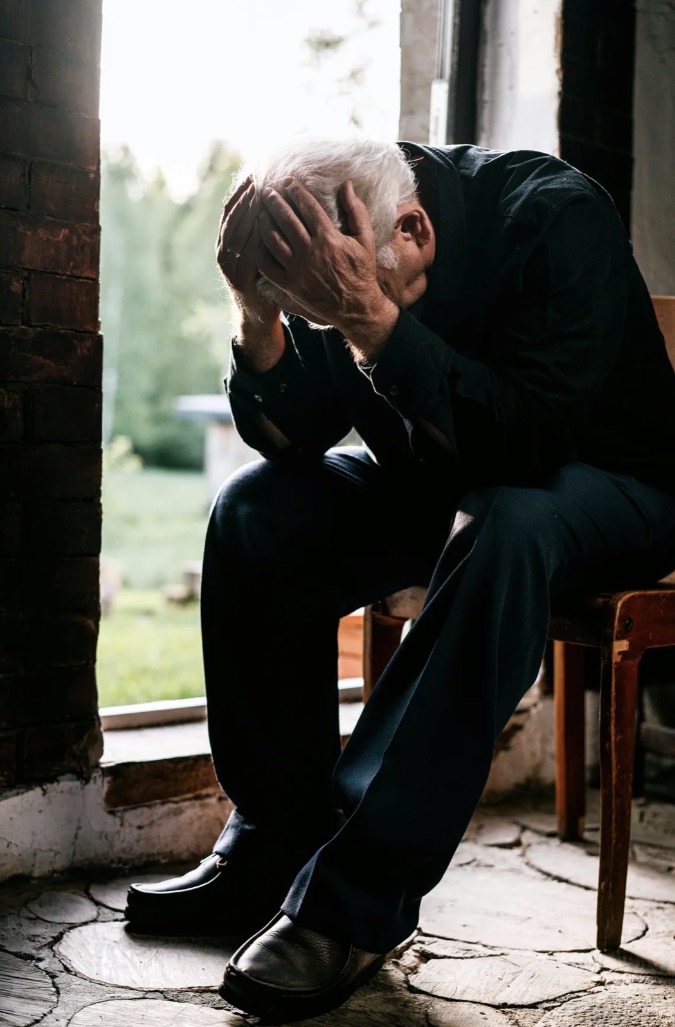
And near the window, alone at a round table, sat a man Mark didn’t recognize.
Late seventies, maybe older. Blue button-down shirt tucked neatly into gray slacks. A trimmed white beard. Hands folded in his lap. His tray sat untouched—turkey cooling into rubber, mashed potatoes stiffening into pale glue. Even the roll, usually the first thing people grab, sat untouched.
Mark paused at the nurse’s desk.
“New resident?” he asked.
The nurse glanced up. “Mr. Harlow. Been here about eight months.”
“Eight months?” Mark frowned. “I’ve never seen him.”
“You’re mostly nights,” she said. “He doesn’t get visitors. Keeps to himself. Always has.”
Mark didn’t know why that bothered him so much. Maybe it was the way the nurse said it, like she was describing a piece of furniture no one ever moved.
On his next round, he walked over.
“Mind if I sit?” Mark asked, pulling out a chair.
The man didn’t look up. “You’re already standing there.”
Mark took that as permission and sat anyway.
“Is the food any good today?”
The man exhaled a dry laugh. “Tastes like paper and sorrow.”
Mark smiled. “Yeah. That tracks.”
They sat in silence. Not the comfortable kind. The kind that stretches.
After a moment, the man spoke again, still staring at his plate.
“No reason to celebrate. Everyone’s gone. No one remembers I exist.”
The words weren’t dramatic. They were flat. Worn thin by repetition. Like something he’d said to himself too many times to count.
Mark didn’t know what to say to that. He tried small talk. Weather. The football score. The man nodded once, then went quiet again.
Later, at the desk, Mark flipped through the visitor log.
Mr. Harlow’s page was empty.
No names.
No signatures.
No cards.
Eight months of nothing.
The thought stuck to Mark like a burr. He finished his rounds, but the image wouldn’t leave him: that untouched tray. A holiday meant for family spent staring at beige food and a window that looked out onto a parking lot.
Half an hour later, Mark did something impulsive.
He knocked on his supervisor’s door.
“I know this is against policy,” he said, already bracing for the look. “But I want to take Mr. Harlow outside. Just for a bit. It’s nice out. He hasn’t left the building in weeks.”
His supervisor stared at him. Long pause.
“Ten minutes,” she said finally. “I’m logging it. Don’t make this a habit.”
Mark found Mr. Harlow still sitting there, staring at the same cold plate.
“Ever sit outside anymore?” Mark asked.
The man shrugged. “No point.”
Mark pushed the chair back. “Come on. Fresh air won’t kill you. Probably.”
Mr. Harlow snorted despite himself.
They rolled his chair out the side exit into a small courtyard. Winter sunlight slanted low across the concrete. A few stubborn leaves skittered in the breeze. Somewhere beyond the fence, traffic hummed.
For a long moment, Mr. Harlow said nothing.
Then, quietly:
“I used to host Thanksgiving.”
Mark turned to him.
“Yeah?”
“Twenty people. Loud. Messy. My wife hated the chaos. Pretended she didn’t, but she did.”
A pause.
“She’s been gone six years.”
Mark nodded. He didn’t rush the silence this time.
“My son stopped calling after the funeral,” Mr. Harlow went on. “Daughter moved overseas. I don’t blame them. I wasn’t easy to love.”
“That doesn’t mean you deserve to be forgotten,” Mark said before he could stop himself.
The old man finally looked at him. Really looked at him.
For a second, something like surprise flickered across his face.
They sat there until Mark’s radio crackled, calling him back inside.
The next day, Mark brought two coffees from the vending machine. One for him. One for Mr. Harlow.
The day after that, he brought a deck of cards.
By Christmas, Mr. Harlow had started leaving his room on his own.
By spring, he was eating in the common room, tray no longer untouched.
Months later, Mark found his name in the visitor log.
One name.
One signature.
Mr. Harlow’s daughter had called. Then visited.
They didn’t fix everything. But they started.
Mark finished telling me this story and stared at his coffee like it held answers.
“I didn’t change his whole life,” he said. “I just sat down. That was it.”
But sometimes, sitting down is the whole difference.
Because being seen—really seen—can pull someone back from the edge of disappearing.

Sophia Reynolds is a dedicated journalist and a key contributor to Storyoftheday24.com. With a passion for uncovering compelling stories, Sophia Reynolds delivers insightful, well-researched news across various categories. Known for breaking down complex topics into engaging and accessible content, Sophia Reynolds has built a reputation for accuracy and reliability. With years of experience in the media industry, Sophia Reynolds remains committed to providing readers with timely and trustworthy news, making them a respected voice in modern journalism.