At 6:00 a.m., the fluorescent lights flickered to life inside the segregation wing of the Huntsville Unit, the oldest prison in Texas and the place where the state carries out its most final sentences. The corridor was quiet except for the low hum of electricity and the echo of measured footsteps. On death row, mornings were heavy, but this one felt different. This one had a deadline.
Daniel Foster had been awake long before the guards reached his cell. Sleep had abandoned him sometime in the night, replaced by a flood of memories—his wedding day, his daughter’s first steps, the smell of rain on the porch of the house he once called home. In a matter of hours, the state of Texas intended to end his life by lethal injection.
For five years, Daniel had lived in a concrete box no larger than a parking space. For five years, he had shouted his innocence into walls that never answered back. The evidence had been described as overwhelming: his fingerprints on the weapon, blood on his clothes, a neighbor claiming to have seen him leaving the house the night his wife died.
Yet Daniel had never confessed. Not once.
When the guards stopped at his cell that morning, one of them cleared his throat and read from a clipboard in a voice trained to be neutral.
“It’s time to prepare.”
Daniel nodded. His face was thinner than it had been during the trial. His hair, once dark, had begun to gray at the temples. He stood slowly, chains clinking as they were secured around his wrists and ankles.
“I have one request,” he said, his voice hoarse from disuse. “I want to see my daughter. Just once. Please let me see Emily before it’s over.”
The younger guard shifted uncomfortably. The older one avoided eye contact.
Requests like that were rare. And they were almost never granted.
But the request did not die in the hallway. It made its way, quietly and unexpectedly, to the office of Warden Robert Mitchell.
Mitchell had overseen more executions than he cared to count. At 60 years old, he had learned to compartmentalize—had learned to believe that the system, flawed as it might be, generally got it right.
But Daniel Foster’s case had always unsettled him.
The evidence had seemed airtight. Fingerprints. Blood. A witness. A motive, prosecutors said: financial strain and marital discord. The jury had deliberated less than three hours before returning a guilty verdict.
Still, Mitchell remembered the first time he had looked into Daniel’s eyes.
They had not looked like the eyes of a killer.
After a long silence, Mitchell gave the order.
“Bring the child.”
The Visit
Three hours later, a white state vehicle rolled into the prison lot. A social worker stepped out first, clipboard tucked under her arm. Beside her stood an eight-year-old girl with pale blonde hair and solemn blue eyes.
Emily Foster had not seen her father in three years.
She walked through the metal gates and down the corridor without crying. Without trembling. Inmates inside their cells fell silent as she passed. Even hardened men who had long ago given up on tenderness watched her with something like reverence.
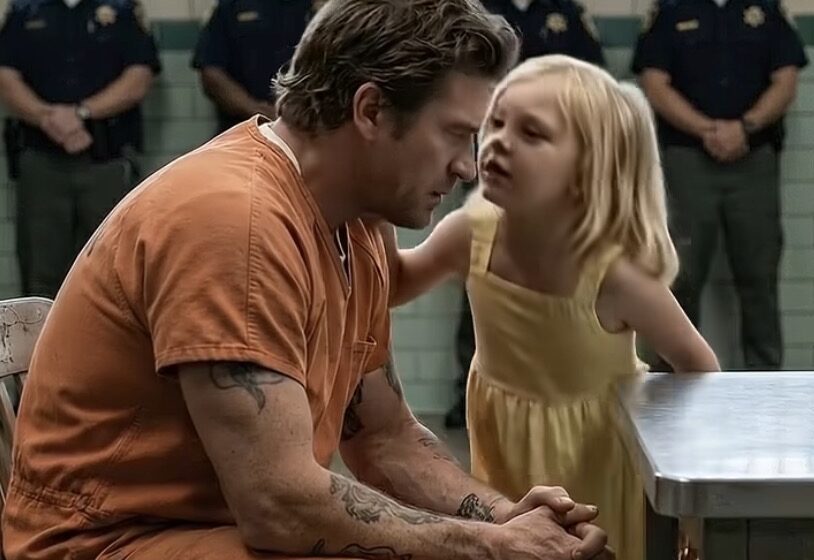
When she entered the visitation room, Daniel was already there, shackled to a steel table. He looked smaller than she remembered. Thinner. Fragile.
“My baby girl…” he whispered as tears filled his eyes.
Emily stepped forward slowly.
She didn’t run.
She didn’t cry.
She wrapped her small arms around him as far as the chains would allow.
For a full minute, neither of them spoke.
Then she leaned close to his ear and whispered something no one else in the room could hear.
What happened next stunned every guard present.
Daniel went pale. His body began shaking—not with fear, but with something else. Something electric.
He pulled back just enough to look at her.
“Are you sure?” he asked, his voice breaking.
Emily nodded.
Daniel shot to his feet so violently that the chair behind him crashed to the floor.
“I’m innocent!” he shouted. “I can prove it now!”
The guards rushed forward, hands hovering near their belts. But Daniel wasn’t resisting. He was sobbing—sobbing with a desperation that felt different from the hopeless grief he had carried for years.
From his office, Warden Mitchell watched the entire scene on a security monitor.
Something had changed.
Within the hour, he made a decision that would put his career—and possibly his freedom—at risk. He picked up the phone and called the office of the Texas Attorney General’s Office.
“I’m requesting a 72-hour stay of execution,” Mitchell said.
There was silence on the other end.
“What new evidence?” the voice demanded.
Mitchell stared at the paused image of Emily’s face on the screen.
“A child who witnessed something,” he replied quietly. “And I think we convicted the wrong man.”
A Case Reopened
Two hundred miles away in suburban Dallas, retired defense attorney Margaret Hayes was pouring her morning coffee when the news alert flashed across her television screen.
Execution Halted After Emotional Prison Visit.
Margaret nearly dropped the mug.
She had retired five years earlier, but she still followed capital cases closely. Early in her career, she had failed to save a man later proven innocent. The mistake had haunted her every day since.
When Daniel Foster’s face appeared on screen, she felt something tighten in her chest.
She recognized that look.
Within hours, Margaret had driven to the courthouse to request access to the five-year-old case file. She worked through the afternoon and into the night, flipping through transcripts, forensic reports, and financial documents.
What she found disturbed her deeply.
The prosecutor who had secured Daniel’s conviction—now Judge Alan Brooks—had personal business ties to Daniel’s younger brother, Michael Foster. Public records showed that Michael had inherited the majority of the Foster family estate shortly after Daniel’s arrest.
Even stranger, Daniel’s wife, Laura Foster, had been researching financial irregularities in the weeks before her death.
Margaret began connecting dots that no one else had wanted to see.
The Drawings
After the prison visit, Emily stopped speaking entirely.
At the state children’s home where she had been living under the guardianship of her uncle Michael, she communicated only through drawings.
One drawing stood out.
It showed a house. A woman on the floor. A man in a blue shirt standing over her. And another small figure hiding in a hallway.
Daniel had never owned a blue shirt.
Michael wore them constantly.
A child psychologist reviewing the drawing noted signs of trauma—but also consistency. The details repeated across multiple images: the blue shirt, the hallway, the hidden vantage point.
Margaret obtained copies of the drawings and added them to her growing file.
Time was running out.
The Man Who Disappeared
With less than 30 hours remaining before the rescheduled execution window would reopen, Margaret received a phone call from a number she didn’t recognize.
“My name is Ethan Reyes,” the voice said. “I used to work for the Foster family. I saw what happened that night.”
Ethan had been the family’s landscaper. He had disappeared days after Laura’s death, reportedly leaving town without notice.
“I didn’t know who to trust,” he said. “But if they kill Daniel, an innocent man dies.”
He agreed to meet Margaret at a roadside diner.
What he revealed was beyond anything she had imagined.
Laura Foster had not died that night.
Ethan claimed he had found her barely alive after Michael attacked her. He had helped her escape before Michael could return. In the chaos that followed, a body from a nearby hospital—misidentified through falsified dental records—had been used to stage Laura’s death.
Margaret stared at him in disbelief.
“Where is she now?” she asked.
Ethan’s answer changed everything.
“In hiding,” he said. “Waiting.”
The Woman the World Buried
By the next morning, Margaret was driving toward a safe house outside San Antonio.
When the door opened, she came face to face with a woman the world believed was dead.
Laura Foster looked older, thinner—but undeniably alive.
She had spent five years in hiding, gathering evidence. She had recordings. Audio files of Michael threatening her. Of Judge Alan Brooks discussing how to “handle” Daniel and ensure the child remained silent.
Laura had feared coming forward too soon. She had believed that exposing the conspiracy without airtight proof would only endanger Emily.
But when she learned of Daniel’s impending execution, she knew she could wait no longer.
Meanwhile, back at the Huntsville Unit, Daniel slept peacefully for the first time in years.
He now understood what his daughter had whispered:
“Mom is alive. I saw her.”
The Motion That Shook the State
Armed with audio recordings, financial records, psychological evaluations of Emily’s drawings, and sworn statements from both Laura and Ethan, Margaret filed an emergency motion before the Supreme Court of Texas.
The motion alleged corruption, conspiracy, attempted murder, fraud, and wrongful conviction.
The court responded within hours.
The execution was halted indefinitely.
News of the case spread rapidly. Public outrage followed.
Michael Foster was arrested and charged with attempted murder, fraud, and conspiracy. Judge Alan Brooks resigned within days and was later indicted on corruption charges.
Five years of lies collapsed in less than a week.
Justice in a Whisper
In the months that followed, Daniel was exonerated.
The forensic evidence that had once seemed airtight unraveled under scrutiny. Fingerprints had been selectively presented. Blood evidence had been mishandled. The neighbor’s testimony fell apart under cross-examination.
Laura testified in open court, describing the night she narrowly escaped death. Ethan corroborated her account.
Emily, now surrounded by protection and therapy, slowly found her voice again.
The moment that had changed everything remained simple.
A child leaning into her father’s ear.
A whisper.
Sometimes justice arrives loudly, with flashing lights and courtroom drama.
Sometimes it arrives quietly—on small feet, through prison corridors, in a voice barely above a breath.
And sometimes, that whisper is enough to stop an execution, expose corruption at the highest levels, and restore a family that the system nearly erased forever.
Because in the end, truth does not always roar.
Sometimes… it whispers.

Sophia Reynolds is a dedicated journalist and a key contributor to Storyoftheday24.com. With a passion for uncovering compelling stories, Sophia Reynolds delivers insightful, well-researched news across various categories. Known for breaking down complex topics into engaging and accessible content, Sophia Reynolds has built a reputation for accuracy and reliability. With years of experience in the media industry, Sophia Reynolds remains committed to providing readers with timely and trustworthy news, making them a respected voice in modern journalism.