Eight Feet of Resolve
Inoticed it before I noticed anything else. Not the house, not the trees going orange and red at the edges of my property, not even Daisy barking from inside the truck where I’d left the window cracked. It was the light. Too much of it. My headlights swept across the yard as I turned onto the gravel drive, and where there should have been wood and shadow at the north boundary, there was just open air, and through that open air I could see straight into my neighbor’s patio, warm yellow light spilling from a string of bulbs they’d hung between two posts, and the silhouette of a volleyball net stretched across what had been, a week ago, the enclosed privacy of my own land.
I stopped the truck halfway up the drive and sat for a moment with the engine running. Daisy had stopped barking and was pressing her nose against the window glass, trying to understand the same thing I was. I turned off the headlights. In the dark, the absence was even clearer. The jagged silhouettes of broken fence posts jutted from cracked concrete footings along the north line like something had come through in a storm. Boards were piled on my side in a loose, indifferent heap, the way you stack debris after clearing it without particularly caring where it lands.
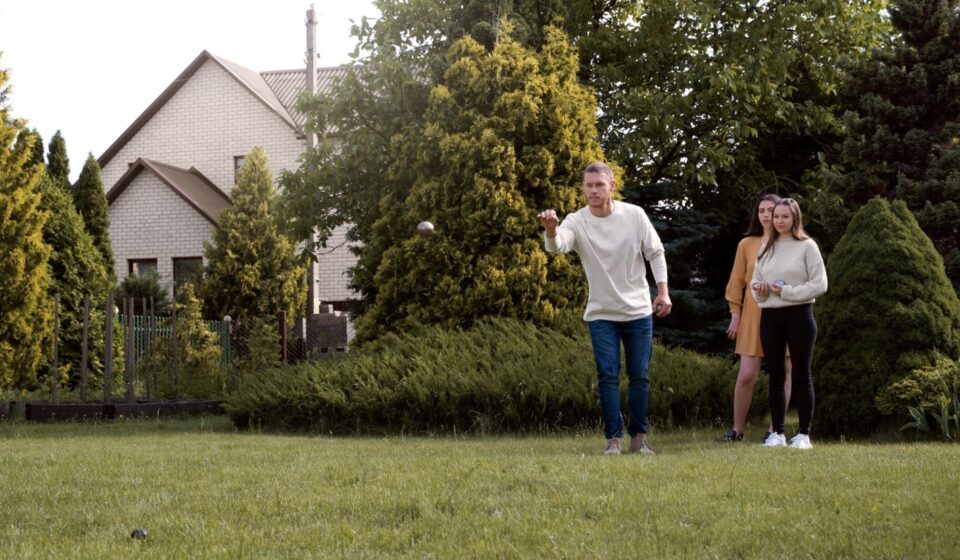
Their boys were playing under the volleyball net. Laughing, diving in the grass. And Ethan Carter stood on his back patio with a set of grilling tongs, flipping something over a flame, the picture of a man having a perfectly fine Tuesday evening.
I got out of the truck slowly.
To understand what I felt crossing that yard toward him, you need to understand what that fence was. Not structurally, not legally, though both of those things matter and I’ll get to them. You need to understand what it meant to a man who spent his thirties in Charlotte doing construction management, grinding through long hours and city noise and the particular exhaustion of a life organized entirely around other people’s timelines, and who promised himself at forty that he would get somewhere quiet and make it his own and keep it that way.
I bought three wooded acres at the edge of a gravel road in 2014. Nothing spectacular, no creek or mountain view, just mixed hardwood forest and good soil and a silence at night so complete you could hear your own heartbeat. I built the fence in 2016, after two years of saving and planning. Six feet of pressure-treated pine set in concrete footings every eight feet, running the full perimeter, just under two hundred linear feet along the north boundary where my land met the neighboring lot. I dug every post hole myself with a rented auger that tried to wrench my wrists out of their sockets on the rocky ground. My friend Caleb came over on weekends to help set the panels, and when we finished we sat on overturned buckets and drank cheap beer while the smell of fresh-cut pine mixed with the late evening air, and I remember thinking this is the thing, this is the exact thing I was working toward for ten years.
That fence kept Daisy in the yard and deer out of the garden and the world at a manageable distance. When I closed the gate at night, I felt it, an uncomplicated sense of completion that city life had never once provided. The previous owners of the house next door, an older couple who eventually downsized to be closer to their grandchildren, never had a word to say about it. We waved from our driveways. Sometimes talked about weather. It was, for several years, exactly the kind of arrangement I had moved there to have.
The Carters arrived in spring. Ethan and Mara, mid-forties, two boys, an SUV with Illinois plates, and the particular energy of people who have decided that a smaller place will be better for them without fully reckoning with the possibility that smaller places have their own established rhythms that don’t reorganize themselves around new arrivals. Ethan came over the day the moving truck pulled up, firm handshake, good smile, the kind of man who scans your property while he’s shaking your hand. He told me he was remote now, corporate strategy for a tech firm in Chicago, that they wanted a slower pace for the boys. Mara talked about community, about how excited she was to open things up. I didn’t think much of that phrase at the time.
About a month in, I found Ethan standing at the north boundary with his fingers hooked over the top rail of my fence, looking at it with an expression that would have been more appropriate aimed at a used appliance left at the curb. He turned when he heard me coming across the yard with Daisy on her leash and gave me the polished smile that was already becoming his default setting for conversations he had decided in advance would go a particular way.
“You ever think about taking this down?” he asked.
I scratched Daisy behind the ears and let the question hang for a second. “Taking what down?”
“This.” He patted the fence rail. “It’s a little much, don’t you think? We’re neighbors. We could open up the yards, make one shared space. The boys would have room to run. It’d feel more like a neighborhood.”
“I built that fence,” I said. “It’s on my property line. I like my privacy.”
He smiled again, but it arrived slightly late, the way smiles do when they’re covering something that moved across the face first. “Property lines are just lines on paper,” he said. “We’re in this together now, right? Community.”
“Not that kind of community,” I said, and kept my tone easy enough that it wouldn’t sound like a fight. “Fence stays.”
He held my eyes a beat longer than the conversation required, then nodded with the careful neutrality of a man filing something away for later. I walked back to the house and didn’t think too much about it. Maybe I should have.
The next few weeks had a quality I can only describe as orchestrated. Their boys developed a habit of kicking soccer balls against the fence panels in long, repetitive sequences, not playing exactly, just impacting, testing resonance. Mara mentioned to me at the mailbox how closed off the neighborhood felt compared to their old place in Lake Forest. Ethan had a contractor over one Saturday running a measuring tape along the boundary, and when I asked what they were looking at, he said just exploring options, with the easy vagueness of someone who has decided they’re not required to explain themselves.
The week I left for the Gulf Coast, Ethan saw me loading the truck. Heading out, he said. Just a few days, I said, beach break. He smiled. Enjoy the openness. I thought it was just one of his comments, the kind that sounds like nothing specific and therefore can’t be held against him. Seven days later I turned onto my gravel driveway at dusk and understood what he had meant.
I walked across the exposed dirt line toward his patio in the same state of suspended unreality you enter when something so clearly wrong has already happened that your brain is still negotiating with the evidence. Ethan turned from the grill when he heard me coming, and he did not flinch. Not in his face, not in his posture. He said welcome back with the casual warmth of a man who has done nothing that requires an accounting.
“What happened to my fence?” I said.
“We took it down. It was an eyesore.”
I said his name once, low, and he kept talking. Their landscape architect had said the flow between the properties would be so much better without a barrier. The boys needed room. It was healthier, more open, better for everyone. Most of the wood was already at the dump. The disposal had run them twelve hundred dollars and if I wanted to split that we could sort it out over Venmo.
There is a kind of anger that doesn’t run hot. It goes the other direction entirely, cold and deliberate, like the body has decided that emotion would be imprecise and what this situation requires is precision. I stood there in the cooling evening air with Daisy pacing behind me in a yard that was no longer enclosed and looked at Ethan Carter’s untroubled face and understood that this was not thoughtlessness. Thoughtlessness would have had some awkwardness in it, some acknowledgment of the line being crossed. This was something else. This was someone who had decided that my preferences about my own land were a problem to be managed rather than a reality to be respected, and who had acted on that decision while I was gone because the timing was convenient.
I told him the fence had been mine, on my property, lawfully installed, and he said you’ll adjust. Once you get used to the openness you’ll thank us. I walked back to my house without another word, took out my phone, and started photographing everything. The broken posts in their cracked concrete sleeves. The piled boards. The volleyball net planted directly over my boundary line. Then I went inside, sat at the kitchen table with Daisy’s head on my knee, and called Laura Bennett.
Laura had been two years behind me in high school, one of those people you stay loosely in touch with across decades, the occasional holiday message, a comment on a shared memory someone digs up and posts. She had gone to law school and built a real estate practice and developed, by all accounts, a reputation for being precise and unhurried and genuinely difficult to rattle. I hadn’t talked to her properly in years. When she answered, I said I had a situation and she said tell me.
I told her everything. She was quiet while I talked. When I finished, she asked me to send the photographs. I sent them while we were still on the phone and heard her open them on the other end. There was a silence of several seconds.
“They did what,” she said. It wasn’t a question. It was the quiet articulation of someone who has just seen a thing clearly and is giving it its correct name.
I said I wasn’t sure what my options were.
“This is textbook trespass and destruction of property,” she said. “They entered your land and removed a structure that was legally installed and belonged to you. That’s not a neighborhood disagreement. That’s deliberate.” She paused. “I want you to hear that. This was deliberate. Whatever story they’re telling themselves, they waited until you were gone.”
I hadn’t fully understood how much I needed someone to say that out loud. There had been a voice running underneath my anger since I’d gotten home, quiet and corrosive, asking whether I was overreacting, whether this was a cultural gap between how things are done in cities versus small-town western North Carolina, whether reasonable people could look at the same situation and see a misunderstanding. Laura’s voice cut through all of that with the efficiency of a woman who has spent twenty years cutting through the stories people tell to avoid accountability.
“What do we do?” I asked.
“We start with a demand letter. Immediate restoration to original condition, at their expense. If they ignore it, we escalate.”
“Do it,” I said.
She drafted the letter that afternoon. I read it the next morning and it was everything I couldn’t have written myself: precise, legal, referencing the county property records and my original survey and the building codes that permitted six-foot privacy fencing on residential lots of my classification. It cited specific statutes. It left nothing soft to push against. She sent it certified mail and emailed a copy directly to Ethan. Then we waited.
Two days later, the response came not from Ethan but from a firm in downtown Chicago, three attorneys on the letterhead, a tone that managed simultaneously to be polished and condescending. They argued that the fence had been structurally compromised and represented a potential safety hazard. They described the removal as a good faith effort to address shared aesthetic concerns, and somewhere in the second paragraph they used the phrase shared property, which was not accurate by any available definition. Their proposed resolution was a three-foot decorative hedge installed along what they called the approximate boundary, which was their way of suggesting that the actual boundary was a matter of interpretation rather than a documented legal fact.
When Laura read the letter aloud in her office, she paused partway through and just blinked once at me, the expression of a person encountering something that confirms a prior assessment rather than challenging it. “They’re trying to reframe the whole thing as a landscaping preference dispute,” she said. “If it becomes about taste or aesthetics, they think they have room to maneuver. We keep it on the legal facts.”
She filed for an emergency injunction with the county court. She attached the photographs, the survey plat, copies of my building permits, a property records summary, and the demand letter alongside the Chicago firm’s response. Within a week we had a hearing date.
Word travels in small places. By the time the court date came, half the people on our road knew something was in motion. Caleb drove over to sit in the back row, which was the most direct form of support he knew how to offer. Mrs. Delaney from down the road squeezed my arm on the courthouse steps and said don’t let them bully you in the matter-of-fact tone of someone who has watched enough of the world to know what bullying looks like when it wears a suit.
The Carters walked in looking like they were attending a corporate presentation, Ethan in a jacket, Mara with a leather portfolio, the performance of people who want to signal that they belong in formal settings and know how to conduct themselves in them. They didn’t look at me.
Judge Whitaker was a silver-haired man with the patience of someone who has been in this room for enough years that nothing people do surprises him and very little impresses him. He reviewed the photographs at a measured pace, adjusted his reading glasses, and looked over the bench at Ethan with the specific expression of a judge who has arrived at a question whose answer he already knows.
“You removed a fence that was not on your property,” he said. It was framed as a question but it wasn’t one.
Ethan stood. He began to explain about deterioration and barriers and the shared benefit of open space, and Judge Whitaker raised one hand and said was it on your property, and Ethan hesitated for a fraction of a second that was one of the most revealing fractions of a second I have ever witnessed in a room, and then he said technically the boundary may, and the judge said was it on your property, and Ethan said no, your honor.
The courtroom went quiet in the way that rooms go quiet when a central fact has been stated aloud and everyone is absorbing it.
Judge Whitaker looked at the survey plat, then back at Ethan. “You do not get to redefine property lines because you find them inconvenient,” he said. “The plaintiff’s fence was lawfully permitted and established. You will restore the fence to its original specifications within fourteen days, at your expense. Failure to comply will result in further penalties and sanctions.” He tapped the edge of the documents once. “That’s all.”
Outside the courthouse, Ethan came up beside me with his voice dropped to the register people use when they want to say something cutting while maintaining the plausible deniability of having spoken quietly. “This is ridiculous,” he said. “You’re turning a neighborhood misunderstanding into something adversarial.”
I looked at him for a moment. “You tore down my fence,” I said. “That was the adversarial act. Everything since then has been response.”
He shook his head slightly, the small performative headshake of a man who has decided that reality is being unreasonable to him, and walked to his car with Mara a step behind him.
The fourteen days that followed were their own kind of instruction. No contractors appeared. No material was delivered. The volleyball net stayed in place. On day eight, a small fire pit showed up on their side near the old boundary line, positioned with a precision that suggested it was not chosen for its relationship to existing outdoor furniture but for its relationship to me. On day thirteen, Laura called Ethan directly with me on speaker, her voice holding the particular quality of a person who has neither the time nor the inclination for further performance.
“Tomorrow is your deadline,” she said. “When does reconstruction begin?”
Ethan’s voice was smooth, the smoothness of a man who has been smooth for so long it has become structural. “We’re evaluating our options,” he said.
“You have one option,” Laura said. “Rebuild the fence.”
“We may be pursuing an appeal.”
“You can pursue an appeal from behind a restored fence,” she said, and ended the call.
That night I lay in bed with the ceiling fan turning and the distant sound of crickets coming through the screen, and every few minutes a drift of laughter from the open yard that shouldn’t have been open, and I thought about the full shape of what had happened. Not just the fence, not just the legal situation. I thought about Ethan’s face when he said enjoy the openness the morning I left for vacation, the completeness with which he had planned this, the way he had stood at the grill flipping burgers when I came home as if the demolished boundary of my property was simply an improvement he had done me the favor of making. I thought about every small pressure in the months before, the soccer balls, the contractor with the measuring tape, the casual references to shared space and community, each one a test of whether I would give ground before he decided to simply take it.
There is an anger that doesn’t explode. It accumulates. It gets very quiet and very specific. By the morning of day fifteen, when Laura called at five-thirty to say they hadn’t filed an appeal and hadn’t rebuilt anything, that anger had clarified into something that felt less like emotion and more like a building material.
“You want the original fence back?” Laura asked. There was a quality in how she asked it, careful and knowing at once, that told me she already understood the question wasn’t simple.
“I want something they can’t mistake,” I said.
She exhaled. “I thought you might say that.”
I had already been in touch with a surveyor, a man who came out and walked the north boundary with a GPS unit calibrated to the county’s coordinate system, checking every point against the original plat. He drove bright orange stakes into the soil at intervals, each one exactly where the law said my land ended and theirs began. He worked methodically and without commentary until he’d finished and then looked up at me. “Your original fence was fully on your land,” he said. “Not even close to the line. You had nearly six inches of clearance on their side.”
Good, I said.
Then I called Miguel.
Miguel ran the fencing company that had supplied my original panels eight years before, a family operation he’d built from a one-truck business into a crew of six with a reputation for doing the work exactly right and not cutting corners on the things that mattered. I’d referred him to two neighbors over the years. When I told him what had happened he was quiet for a moment and then said every inch, like he wanted to make sure he had heard me correctly. Every inch, I confirmed. He asked if I wanted wood again and I looked out at the open stretch of dirt where the Carters’ boys were riding bikes across the space that used to be the interior of my enclosed property.
“Steel,” I said.
He raised an eyebrow. “How high?”
I thought about the six feet that had once felt substantial. The six feet that had been removed and hauled to a dump and replaced with a volleyball net while I was eating shrimp tacos on the Gulf Coast. “Eight,” I said.
Miguel smiled slowly, the smile of a craftsman who has just been given interesting work. “That’ll be permanent,” he said.
We laid it out carefully over the following days. Steel posts set in deep concrete footings, the footings going down further than code required because I wanted the concrete mixed right and poured correctly and I did not want to have this conversation again in ten years or twenty. Solid steel panels with no gaps, no decorative lattice, no visibility in either direction. Not ornamental. Not hostile in any aesthetic sense, just clean and industrial and completely final, the material language of a person who has decided that this particular question is now closed.
Two pickup trucks and a concrete mixer came up my drive at dawn on day fifteen. The rumble of the engines in the early stillness was a different sound than the sound of an argument or a court date. It was the sound of construction, of something being made permanent. Miguel handed me a hard hat with the practical ease of a man who considers a hard hat appropriate regardless of scale, and the crew began unloading equipment with the quiet efficiency of people who have done this enough times that every motion is already decided.
The Carter’s back door slid open before the first auger hole was finished. Mara came out with a coffee mug and a confused expression that resolved into something harder when she took in the survey stakes, the stacked steel panels, the concrete mixer turning in my driveway. Ethan followed in gym shorts, still waking up, and stood at the edge of their patio doing the same rapid calculation.
“What is this?” he called across the yard.
I walked to the boundary stakes and planted my feet just inside my property. “You had fourteen days,” I said.
He looked at the steel panels stacked in the truck bed, then back at me. “You can’t be serious.”
“I’m completely serious.”
Miguel fired up the auger. The first hole went down exactly on the survey mark, the bit chewing into clay and sending up the particular smell of damp earth opened to air, and I stood there watching it and thinking about how different that sound was from the silence of coming home to nothing but broken posts. That had been absence. This was construction. There is a profound difference between the two in the way they feel in your body.
Ethan moved closer to the boundary line, barefoot now, arms crossed. “You’re overreacting,” he said. “This is hostile.”
Miguel kept his eyes on the auger, guiding it straight and level as if no one else were speaking.
I looked at Ethan without any particular feeling, just clarity. “You tore down my fence,” I said. “This is compliance with a court order.”
The concrete came gray and thick into the first footing, settling around the base of an eight-foot steel post with the specific authority of something that is done being argued with. The crew worked with a precision that made the whole operation feel less like a confrontation and more like engineering. Levels and laser lines, each post checked twice before the concrete set. Miguel moved down the boundary in a straight line that corresponded exactly to the orange survey stakes, post by post, footing by footing, the work proceeding with an indifference to audience that I found genuinely satisfying.
Mara had come off the patio and into the yard by then, her mug on the table behind her, forgotten. “You’re building a wall,” she said. “What are the neighbors going to think?”
I thought about Mrs. Delaney and her don’t let them bully you on the courthouse steps. I thought about Caleb leaning against his truck in the back row. “The neighbors have already thought about it,” I said. “They watched what happened.”
Ethan’s voice sharpened as the morning progressed and the posts kept going in. “This is going to affect our property value,” he said at one point. “You can’t put up an industrial barrier and pretend it’s a reasonable response.”
“It’s within code,” I said. “It’s on my land. Rural residential allows eight feet.”
“We were trying to improve things,” he said, and his voice had taken on the quality of genuine frustration, which was the first authentic thing I had heard from him since he told me I’d adjust. “We wanted communal space. Something that worked for both families. You’re choosing to make this adversarial.”
I walked close to the boundary line and stopped a foot short of the new posts. “I told you in our second conversation that the fence was staying,” I said. “You waited until I left town and had it demolished. You ignored a court order for fourteen days. You treated my property like a decision you got to make.” I looked at him directly. “This isn’t adversarial. This is what happens when someone decides your boundaries are optional and you demonstrate that they’re not.”
He opened his mouth and then closed it, which was the first time in my experience of him that he hadn’t had something ready.
By midmorning the posts were standing in an unbroken row two feet taller than the original fence. When the crew began sliding the steel panels into place, the openness that had felt like an open wound for the past three weeks started closing, panel by panel, each one locking into the next with a clean metallic sound. No gaps. No slats to peer between. Just a continuous surface of steel that caught the morning light and gave nothing back.
By early afternoon, the last panel was in place.
Miguel wiped his hands on a work rag and stood back and looked at it the way craftsmen look at finished work, with the satisfaction of a person whose relationship with quality is professional rather than personal. “Solid,” he said. “They’re not moving that without a demolition permit and a crew.”
I stood back beside him and looked at it. The fence ran the full north boundary in a straight, uninterrupted line, eight feet of steel and concrete casting a long shadow across my yard in the afternoon sun. Not decorative. Not charming. Unmistakable. Daisy trotted along the inside edge, nose working at the base, and then turned and walked back toward the porch with the uncomplicated contentment of an animal whose world has been restored to its correct dimensions.
I felt it then, the thing I had moved out here for in the first place. The sense of enclosure, of boundary, of a space that was mine and known and closed at its edges. After three weeks of that feeling being gone, its return was so specific and complete that I had to stand there a minute and just let it settle.
Ethan stood on his side of the new line and looked up at the steel with an expression I couldn’t quite read. “This isn’t over,” he said quietly.
I believed him. Which is why Laura was not surprised when the lawsuit papers arrived two weeks later.
He was suing me for seventy-five thousand dollars. The complaint characterized the new fence as a hostile structure erected with retaliatory intent that had significantly diminished the aesthetic character and market value of his property. Retaliatory intent. The language had been chosen carefully to reframe the entire sequence of events around my response rather than his action, to position him as someone who had been harmed by what I’d built rather than someone who had caused everything that followed by tearing down what I’d already had.
Laura read through the complaint in her office with the focused stillness of a surgeon. When she finished she looked up at me. “Did you build the fence on your property?”
“Yes.”
“Does it violate any height restriction or local code?”
“No. County allows eight feet in rural residential.”
“And did he comply with the court order to rebuild the original fence?”
“No.”
She set the papers down. “Then you’re not unreasonable. You’re thorough.” She leaned back. “He’s trying the same reframe he used the first time. Make it about your choices instead of his. Make the consequence look like the cause.” She picked up her pen. “We’re not going to let him do that twice.”
The second hearing had a different weight to it than the first. The room was fuller. Word had spread beyond our road. Ethan had switched to a local attorney, probably on the advice of someone who understood that a Chicago law firm carrying water in a county courthouse was going to generate more irritation than sympathy. His new attorney argued that while I might technically have had the right to rebuild, the choice of material and height constituted a form of intimidation, that the result was a visually oppressive structure incompatible with the rural residential character of the neighborhood.
Judge Whitaker listened with his hands folded, his expression offering nothing.
When Laura stood, she did not dramatize. She laid out a timeline: original fence, lawfully permitted and installed, standing without incident for eight years. Unauthorized demolition while the owner was absent. Demand letter and certified documentation. Court order to restore. Fourteen days of noncompliance. Rebuild executed entirely within county code on the owner’s own land. She paused at the end and let the room be quiet for a moment before she spoke again.
“Your honor, my client did not initiate this conflict. He sought restoration of what was his. The defendants made a series of deliberate choices, beginning with the removal of a lawful structure and continuing through their failure to comply with this court’s order. If the defendants find the result of those choices unpleasant, that is not a harm the law is designed to remedy.”
Judge Whitaker turned to Ethan’s attorney. Then, after a long moment, to Ethan himself.
“Did you remove the original fence without permission?” he said.
Ethan’s attorney started to speak and the judge held up one hand.
“Did you fail to comply with this court’s restoration order?”
A silence that lasted long enough for it to mean something. “Yes,” Ethan said.
Judge Whitaker nodded once, the slow deliberate nod of a man who has heard everything he needed to hear. “You do not get to damage someone’s property, disregard a direct court order, and then seek legal remedy because you dislike the manner in which they exercised their lawful rights on their own land. This case is dismissed. The defendant is responsible for plaintiff’s construction costs and legal fees in full.”
The gavel came down soft and final.
Outside the courthouse, Ethan walked straight to his car without looking at me, jaw set, Mara a step behind him. I stood on the steps for a while and let the air come in and out. Laura came up beside me after a minute and bumped my shoulder lightly.
“You okay?” she said.
I thought about it honestly. “Yeah,” I said. “I think I am. Though it doesn’t feel like winning exactly.”
“What does it feel like?”
I thought about Daisy walking the inside length of the new fence and turning back to the porch. “Like balance,” I said. “Like things being the way they should be.”
That evening I sat on my back porch with iced tea and watched the sun go low behind the tree line. The steel fence along the north boundary caught the last of the light for a few minutes and then faded into the dusk, becoming just a dark line at the edge of my yard, solid and definite and there. On the other side, sounds that had been open and present for three weeks were muted now, contained, no longer drifting freely across a boundary that someone had decided shouldn’t exist.
Daisy lay at my feet in the specific total relaxation of a dog who is certain about where she is and has no reason to be anywhere else. I drank my tea and listened to the crickets come up as the light went down and thought about how easily this could have gone differently. If I’d let it go. If I’d agreed to the hedge and told myself it was keeping the peace. If I’d accepted that Ethan Carter was probably right that I’d adjust, that openness was better, that my preferences about my own land were something to be outgrown rather than defended.
There is a pressure in small communities, and honestly in most human situations, to accommodate. To not make things difficult. To find the version of events where you can avoid conflict by bending your own requirements a little and calling it maturity or flexibility or not making a big deal of things. I had felt that pressure throughout this whole situation, the quiet voice asking whether I was being reasonable, whether a different kind of person would have found a way to get along.
But here is what I kept coming back to: Ethan hadn’t come to me with a conversation. He had come to me with a conclusion. He had decided that my fence was the wrong answer to a question he had asked without asking me, and when I told him no twice he had waited until I was seven hundred miles away and acted anyway. That wasn’t a misunderstanding. That wasn’t a culture gap or a difference in values about community and openness. That was someone deciding that my choices about my own land were subject to his approval, and that his approval was enough to make them disappear.
Boundaries aren’t aggressive. They’re clarifying. The fence I’d built in 2016 had never been about the Carters. It predated them by years. It was about the kind of life I had worked toward and earned and built for myself on three wooded acres at the end of a gravel road in western North Carolina. Ethan had turned it into something about him, about barriers and division and the sort of neighbor I was willing to be, and I had let the courts clarify that the fence was never his to interpret in the first place.
The steel wall he ended up living beside was not something I had planned for. It was what happens when you try to restore something exactly and discover that exact is no longer the right response to what occurred. He had not damaged my fence through negligence or an honest error in judgment. He had removed it deliberately, while I was away, and then spent weeks treating the court order to restore it as an inconvenience rather than an obligation. The eight-foot steel barrier was the answer to a different question than the original six-foot pine fence had been. The original fence said this is my space. The steel said this is my space and we are not going to revisit that question.
We don’t speak now. We don’t wave. When I’m in the yard and he’s in his, there is a wall between us that was made to last, and we move in our separate spaces in the particular quiet of people who have said everything that needed to be said through lawyers and judges and concrete footings and have nothing left to add. Occasionally I wonder about the conversation we might have had if things had gone differently from the start, some version of events where he comes to my door and says I’ve been thinking about asking you something and I invite him in for coffee and we talk it through and end up neighbors in the full sense of the word. Maybe that was possible. I genuinely don’t know. Some people only understand lines when they run into them, and some people who run into them still don’t understand.
What I know is this. The morning I sat in my truck halfway up the gravel drive and understood that my fence was gone, there was a version of me that might have walked over to Ethan’s patio, had the argument, and eventually decided it wasn’t worth the trouble. That version would have been smaller. Not humble, not mature, just smaller, in the specific way that you become smaller when you let someone teach you that what you built and paid for and care about is negotiable if the person challenging it is confident enough.
I didn’t become that version. I called Laura. I photographed the damage and documented the timeline and showed up to the hearings and let the law say what it needed to say, and when the law required action I hired Miguel and poured concrete and drove steel posts into the earth at the exact coordinates the survey said were mine.
The fence stands. Daisy runs the yard in the evenings and comes back to the porch and settles at my feet and has no complicated feelings about any of it, which I have come to regard as a kind of wisdom.
The iced tea gets warm while I sit out there thinking about it, and the crickets are loud in the trees, and the fence is just a dark line at the edge of what’s mine, and when I close the gate at night the feeling is exactly what it was before any of this happened.
The world stays outside.
That’s all it was ever supposed to do.

Sophia Reynolds is a dedicated journalist and a key contributor to Storyoftheday24.com. With a passion for uncovering compelling stories, Sophia Reynolds delivers insightful, well-researched news across various categories. Known for breaking down complex topics into engaging and accessible content, Sophia Reynolds has built a reputation for accuracy and reliability. With years of experience in the media industry, Sophia Reynolds remains committed to providing readers with timely and trustworthy news, making them a respected voice in modern journalism.