The courthouse in downtown Chicago felt colder than usual that morning.
Not because of the air-conditioning.
Because everyone had already decided who she was.
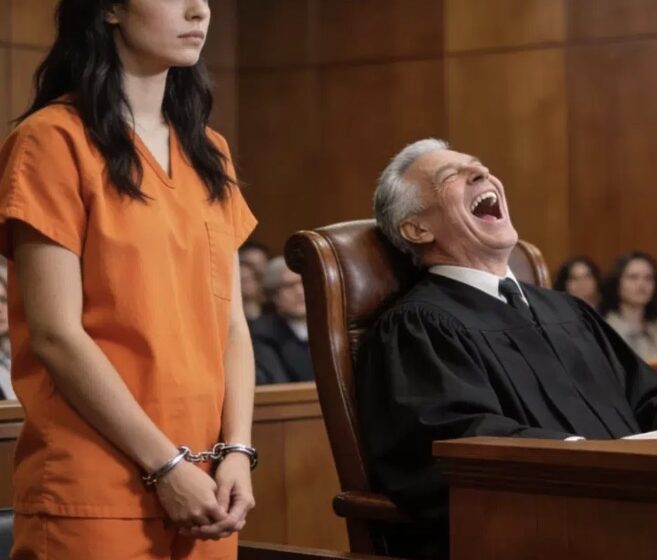
Twenty-three-year-old Emily Carter stood in handcuffs at the defense table, wrists restrained, chin lowered—but not in shame. In restraint.
The clerk read the charges clearly:
“State of Illinois versus Emily Carter. Wire fraud. Identity misrepresentation. Financial deception.”
Assistant District Attorney Richard Coleman spoke first, his voice smooth and rehearsed.
“This woman claimed she was fluent in ten languages,” he said, pacing confidently. “She secured high-paying translation contracts from multinational firms. No degree. No certifications. No academic background. Just a lie.”
A few quiet murmurs rippled through the courtroom.
Judge Harold Whitman barely glanced up from the file.
“And what was her previous occupation?” he asked dryly.
“Cleaning staff,” the prosecutor replied.
Soft laughter echoed across the benches.
Emily lifted her eyes.
Calm. Steady.
“I do speak ten languages,” she said.
The judge sighed. “This is not a performance hall.”
She didn’t blink.
“Then let’s not make it one, Your Honor. Just tell me which language you’d like to begin with.”
The room went silent.
The Test
Annoyed but curious—and perhaps slightly challenged—the judge postponed the hearing for three days. He ordered independent academic verification.
Ten professors were invited. One for each language she claimed.
Three days later, the courtroom was packed beyond capacity.
German came first. A dense legal paragraph.
Emily translated it—not mechanically, but with contextual precision, referencing comparative legal systems.
The professor nodded slowly.
“Accurate.”
Mandarin followed. A technical research abstract filled with scientific terminology.
She translated complex molecular terms without hesitation.
“Impressive,” the professor admitted.
French. Arabic. Russian. Japanese. Spanish. Italian. Portuguese. Formal British legal English.
One by one, the skepticism in the room dissolved.
By the ninth language, no one was laughing.
By the tenth, no one was breathing loudly.
The Arabic professor decided to test depth instead of vocabulary.
“Translate this classical text,” he said. “Then explain its philosophical meaning.”
She did.
Then she expanded on it—speaking about justice, dignity, and how knowledge should never require permission.
The professor lowered his glasses.
“I have no further questions.”
The Truth Behind the Accusation
But fluency wasn’t the only issue.
The prosecution insisted she had misrepresented herself professionally.
That’s when her defense attorney stood.
An independent forensic audit was submitted to the court.
Translation accuracy: 99.8%.
Terminology precision: Above industry average.
Client satisfaction records: Exceptional.
The courtroom doors opened unexpectedly.
A corporate executive stepped inside.
Nervous. Pale.
“I accused her to protect my own position,” he admitted. “The board questioned why someone without a degree was outperforming certified agencies. I panicked.”
A wave of whispers filled the room.
Judge Whitman removed his glasses.
After a long recess, he returned.
“This court finds the defendant not guilty on all charges.”
No applause at first.
Just silence.
Because everyone understood what had really been on trial.
Not fraud.
Prejudice.
What They Never Knew
Emily had never attended an elite university.
She was raised by her grandmother, Maria, who cleaned luxury apartments for diplomats.
While her grandmother worked, Emily listened.
She absorbed languages in kitchens, hallways, and living rooms.
She learned them from children, from arguments, from laughter.
Language wasn’t a résumé line.
It was survival.
It was love.
After the Verdict
Weeks later, Emily declined multiple corporate offers.
Instead, she opened a small language center on the South Side.
Free classes.
No tuition.
No gatekeeping.
She named it after her grandmother.
When asked why, she said simply:
“Because talent shouldn’t need permission.”
Even Judge Whitman visited months later—quietly, without cameras.
And the professors who once doubted her began volunteering.
As for the executive who accused her?
He donated anonymously.
Guilt speaks every language.
That day in court, people thought they were watching a fraud exposed.
Instead, they witnessed something else entirely:
The moment a young woman refused to shrink.
Because intelligence doesn’t live in marble buildings.
It lives wherever someone dares to say:
“I can prove it.”
And she did.

Sophia Reynolds is a dedicated journalist and a key contributor to Storyoftheday24.com. With a passion for uncovering compelling stories, Sophia Reynolds delivers insightful, well-researched news across various categories. Known for breaking down complex topics into engaging and accessible content, Sophia Reynolds has built a reputation for accuracy and reliability. With years of experience in the media industry, Sophia Reynolds remains committed to providing readers with timely and trustworthy news, making them a respected voice in modern journalism.